

Finding Your Purpose - A Manifesto
How Humans Across History Constructed Meaning Inside Reality

Welcome to this week’s issue of RAISINI.
Every week, i write about building a life on your own terms - through music, entrepreneurship, investing, health and brand-building. This isn’t theory. It’s what I’ve lived. Let’s keep going.
If you want access to private chats, live events, workshops, and more, consider becoming a paid or founding member.
This manifesto is written as a short philosophical book exploring how human beings across history constructed meaning, purpose, and psychological stability inside reality.
Introduction (Why I Started Questioning Everything)
Why Humans Need Purpose At All
Civilizations Always Knew Humans Needed Meaning
Why Modern People Feel Lost
Purpose Is Usually Built, Not Found
Borrowed Ambition and Chosen Meaning
Responsibility Is What Stabilizes Meaning
Why Awareness Complicates Purpose
Building Meaning Inside Modern Reality
Purpose Changes As Human Beings Change
A Meaningful Life Is Usually Quieter Than People Expect
Preface -What This Manifesto Is About
Most people spend their lives pursuing goals they never consciously chose.
They inherit ambitions from family, culture, economic systems, social pressure, algorithms, comparison, and survival itself long before they fully understand who they are or what kind of life genuinely feels meaningful to them. Modern society teaches human beings how to become economically functional far more effectively than it teaches them how to live consciously. As a result, many people move through life achieving externally recognizable milestones while remaining internally uncertain about why any of it actually matters.
This manifesto was written to explore that problem seriously.
Not through motivational slogans, productivity advice, or simplistic self-help frameworks, but through philosophy, history, psychology, systems thinking, civilization, and lived experience. The goal is not to provide a perfect formula for purpose because no such formula exists universally for every human being. The goal is to help you understand how meaning is actually constructed across real human lives and why so many modern people feel psychologically lost despite living in materially advanced societies.
Across thousands of years, human beings repeatedly asked the same questions in different forms.
Why are we here?
What is our purpose?
What makes suffering tolerable?
Why do achievement and happiness often fail to create fulfillment?
Why do some people remain psychologically stable during hardship while others collapse under far lighter pressure?
Why does modern life produce so much stimulation while leaving so many people internally fragmented?
Civilizations, philosophers, religions, psychologists, and thinkers across history attempted to answer those questions repeatedly because meaning is not a luxury concern. It is psychological infrastructure. Human beings require orientation. Without it, people drift easily toward distraction, compulsive comparison, emotional numbness, addiction, performance, endless consumption, or quiet existential despair.
This manifesto explores how meaning has historically been constructed, how modern systems disrupt that process, and how individuals can consciously rebuild purpose inside environments increasingly designed to fragment attention and identity.
The chapters move gradually through that progression.
The early sections examine why human beings need meaning at all, why civilizations always constructed systems around purpose, and why modern life leaves so many people psychologically disoriented despite unprecedented freedom and technological advancement. From there, the manifesto explores how purpose is usually built rather than discovered instantly, how many ambitions are inherited unconsciously from surrounding systems, and why responsibility stabilizes meaning more effectively than pleasure alone.
Later sections examine how awareness itself complicates purpose because once inherited narratives collapse, individuals often struggle to reconstruct stable meaning afterward. The manifesto then explores how meaning is built practically inside modern reality through contribution, competence, responsibility, alignment, and conscious participation in life itself. Finally, the closing sections examine how purpose evolves across different stages of life and why meaningful lives are often quieter, simpler, and less performative than modern culture encourages people to believe.
This is not a manifesto about becoming extraordinary.
It is about becoming conscious enough to stop living entirely by accident.
It is for people who feel internally disconnected despite external success. People questioning whether modern systems are organizing human life correctly. People trying to understand why achievement often fails to resolve deeper existential tension. People searching for meaning beyond consumption, status, distraction, and algorithmically inherited ambition.
Most importantly, it is for people who no longer want surface-level answers to existential questions that have shaped human civilization for thousands of years.
Introduction
Why I Started Questioning Everything
I have been thinking more about purpose recently. Maybe it happens naturally when you realize you have likely already lived half your life, assuming you are fortunate enough to reach your eighties or nineties. Time starts feeling different at that stage. Not in some dramatic or cinematic way, but in a quieter and more unsettling one. You begin noticing how quickly entire decades disappear, how ambitions that once felt enormous slowly become memories, and how most people spend the majority of their lives moving from one obligation to another without ever seriously stopping to ask what any of it was ultimately for.
Society teaches people how to survive, but rarely how to understand themselves. You are taught how to study, work, earn money, compete, and become economically functional inside existing systems, but very few people ever sit you down and ask a much deeper question: what is your life actually meant to mean?
I started seriously questioning that nearly twenty years ago after reading Many Lives, Many Masters by Brian Weiss. Whether someone interprets the book spiritually, psychologically, or symbolically matters less than the effect it had on me personally. One idea in particular stayed with me long after I finished reading it: the suggestion that human beings are here not simply to accumulate, survive, achieve, and consume, but also to learn, teach, and develop understanding through experience itself. That idea quietly changed the way I looked at existence. It became the beginning of a much longer internal process where I started questioning not only my own direction, but the structure of modern life itself and the values people organize themselves around.
As the years passed, those questions deepened through experience. I built businesses, produced and released music albums, launched projects, chased ambitions, and achieved many of the goals I once believed would create lasting fulfillment. Yet every time I reached another milestone, the feeling faded surprisingly quickly. There was always another target afterward, another expansion, another pursuit waiting to replace the previous one. Over time, I started realizing that achievement and meaning are not necessarily the same thing. Money solved certain practical problems, but it never fully answered the deeper question underneath them. Material success created momentum, opportunities, and freedom, but it did not automatically create inner clarity. In many ways, the older I became, the less attached I felt to accumulation itself. I found myself increasingly drawn toward simplicity, toward living lighter, toward the kind of intentional minimalism present in parts of Japanese philosophy where meaning is often found less in ownership and more in conscious living.
At the same time, I began observing the world around me differently. I saw how modern systems continuously push people toward comparison, performance, visibility, consumption, and validation while leaving very little room for reflection or self-understanding. Younger generations now have access to more information and opportunity than almost any civilization in human history, yet many seem more psychologically disoriented than ever. Modern connectivity solved the problem of access to people far more effectively than it solved the problem of internal orientation. Entire identities are increasingly shaped around visibility, external approval, and algorithmic attention rather than a deeper understanding of what actually creates a meaningful life. The more I observed this, the more I kept returning to the same question: if human beings can learn how to build companies, manipulate markets, create technologies, and reshape civilizations, why are so few people ever taught how to build a meaningful life?
Part of what intensified these thoughts was the simple awareness of mortality itself. One day I will be gone. The homes I lived in will eventually belong to strangers. My belongings will disappear. Most traces of my existence will gradually fade with time. A few generations from now, almost all of us are forgotten entirely. Strangely, I never experienced that realization as depressing. I experienced it as clarifying because it forced me to think more carefully about what actually survives a human life once material accumulation disappears. Not possessions or status, but ideas, teachings, frameworks, and contributions that continue helping other people navigate reality long after the individual is gone. People still study Epictetus, Seneca, Buddha, and Marcus Aurelius not because those men escaped mortality, but because something deeper than their physical lives continued carrying value across time.
That realization is part of what eventually pushed me toward writing publicly and beginning this Substack years ago. Not because I believe I possess definitive answers, but because I increasingly felt that learning, reflecting, and sharing understanding with others may itself be part of the purpose. In many ways, I am still trying to understand my own place within all of this as I write these words. But perhaps that is the real condition of being human. Across thousands of years, civilizations, philosophers, religions, and ordinary people alike have all wrestled with the same underlying question in different forms: why are we here, and what does it actually mean to live a meaningful life inside reality?
This essay is my attempt to explore that question honestly.
Why Humans Need Purpose At All
One of the strangest contradictions of modern life is that humanity has never possessed more comfort, convenience, technology, or access to information, yet so many people still feel internally lost. Entire generations now have access to knowledge that kings could not access a few centuries ago. A teenager with a phone can learn philosophy, business, science, psychology, history, or almost any technical skill within hours. And yet despite this explosion of access, many people still move through life without understanding why they are doing what they are doing in the first place. They study, work, consume, repeat routines, pursue goals, and continue following paths inherited from the environment around them without ever seriously examining whether those paths are leading toward a meaningful life or simply toward economic survival inside existing systems.
Part of the problem is structural. Most societies educate people for functionality long before they educate them for self-understanding. From an early age, the focus becomes performance, productivity, competition, stability, and social integration. Children are taught how to pass examinations, build careers, earn money, and survive inside economic structures, but rarely how to think carefully about identity, mortality, suffering, responsibility, or meaning itself. The assumption is often that meaning will somehow emerge automatically once success arrives. But for many people, it never does. They spend decades climbing toward goals inherited from family expectations, culture, status incentives, social media environments, or economic pressure, only to eventually realize they never consciously chose the mountain they were climbing in the first place.
This matters because purpose is not merely a philosophical luxury or abstract spiritual idea disconnected from reality. It quietly shapes almost every aspect of human behavior. A person with meaning can tolerate hardship very differently from someone without it. Purpose influences resilience, discipline, emotional stability, long-term decision-making, relationships, sacrifice, and the ability to endure suffering without psychologically collapsing beneath it. Human beings can survive extremely difficult conditions when pain feels connected to something meaningful, but suffering without meaning tends to produce despair much faster because the mind no longer understands what the hardship is for.
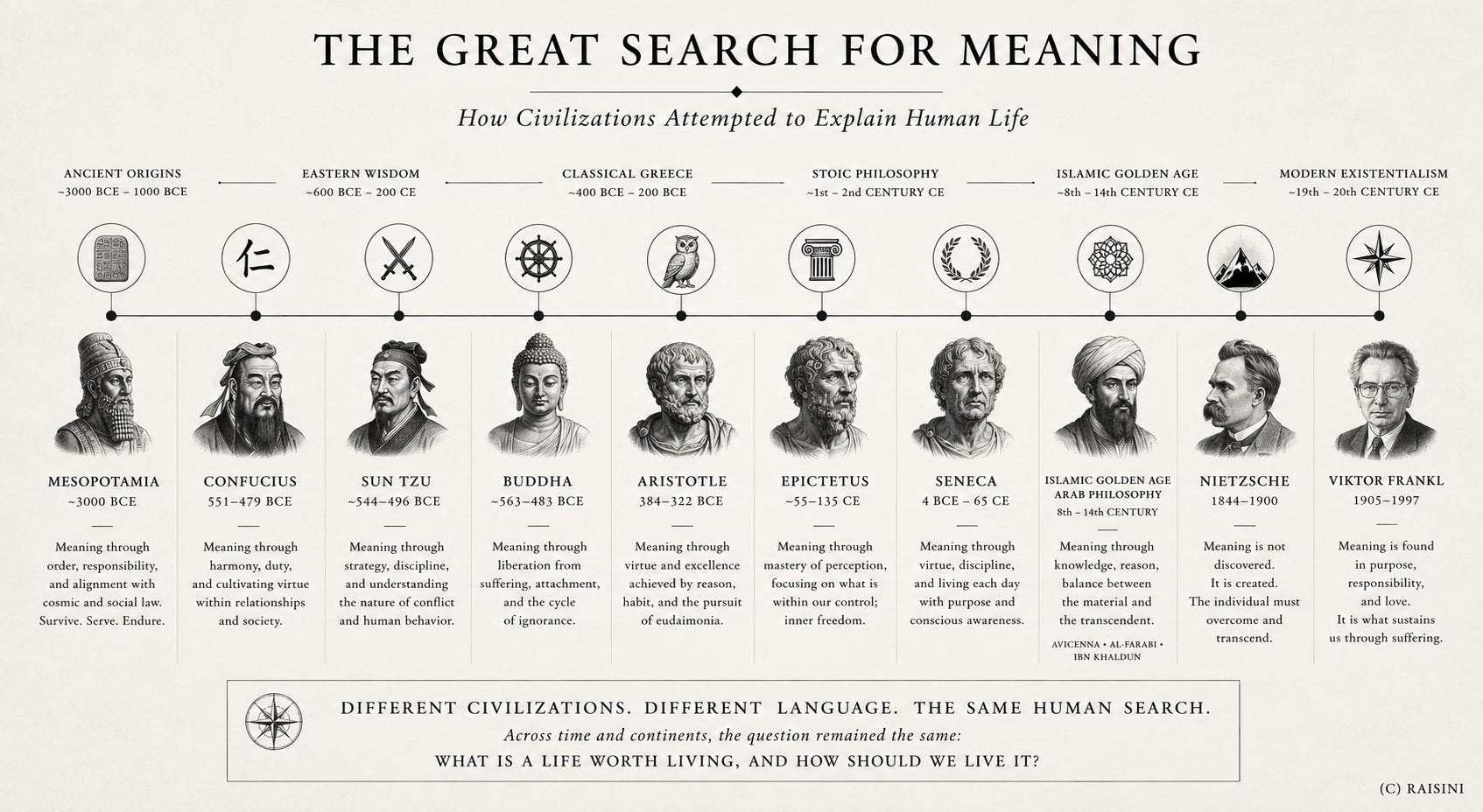
This pattern appears repeatedly throughout history regardless of civilization, religion, or philosophy. Viktor Frankl observed it while surviving concentration camps, arguing that human beings can endure extraordinary suffering when they understand why they are enduring it. Long before modern psychology existed, Aristotle wrote about fulfillment emerging through discipline, virtue, responsibility, and meaningful action rather than temporary pleasure alone. Stoic thinkers like Epictetus and Marcus Aurelius focused on maintaining internal order inside uncertain environments, while Buddhist traditions spent thousands of years exploring suffering, attachment, craving, and the unstable nature of human desire itself. Even Friedrich Nietzsche, often remembered only for his criticism and intensity, warned that human beings psychologically deteriorate when they lose a deeper sense of meaning capable of organizing existence coherently.
The search for purpose itself is therefore not new. Human beings have wrestled with these questions for thousands of years because consciousness creates existential tension. Humans are aware of mortality, uncertainty, suffering, time, and loss in ways most living creatures are not. Meaning became one of the mechanisms civilizations used to stabilize individuals against that reality. It helped people organize sacrifice, endure hardship, build identity, tolerate uncertainty, and remain psychologically functional during periods of instability. Ancient societies often embedded meaning inside religion, family, duty, tribe, survival, or collective identity because civilizations understood that large groups of directionless people eventually become psychologically fragmented and socially unstable.
What changed in the modern world is not the human need for meaning, but the environment surrounding the search for it. Ancient humans lived closer to shared structures of meaning and necessity. Modern humans live inside highly engineered systems competing continuously for attention, consumption, productivity, emotional stimulation, and behavioral influence at industrial scale. The modern world gives people endless choices, but very little clarity regarding which choices actually matter long term. And when people lose that clarity, they often replace purpose with distraction, busyness, entertainment, comparison, status pursuit, or endless movement without direction. Much of modern anxiety and existential disorientation emerges from this exact condition. Human beings never stopped searching for meaning. Modern environments simply became extraordinarily effective at interrupting the search itself.
Civilizations Always Knew Humans Needed Meaning
For most of human history, civilizations understood something modern societies often ignore: people cannot live for very long without meaning. A human being who possesses food, shelter, physical safety, and even material comfort but no sense of direction eventually begins deteriorating psychologically. Ancient societies may not have possessed modern neuroscience, advanced technology, or contemporary economic systems, but they understood something fundamental about human nature that remains true today. Human beings require frameworks capable of explaining why life matters, how suffering should be interpreted, what responsibilities individuals carry toward others, and how a person should move through existence itself. Nearly every enduring civilization attempted to answer those questions in one form or another because societies eventually become unstable when large numbers of people lose orientation entirely.
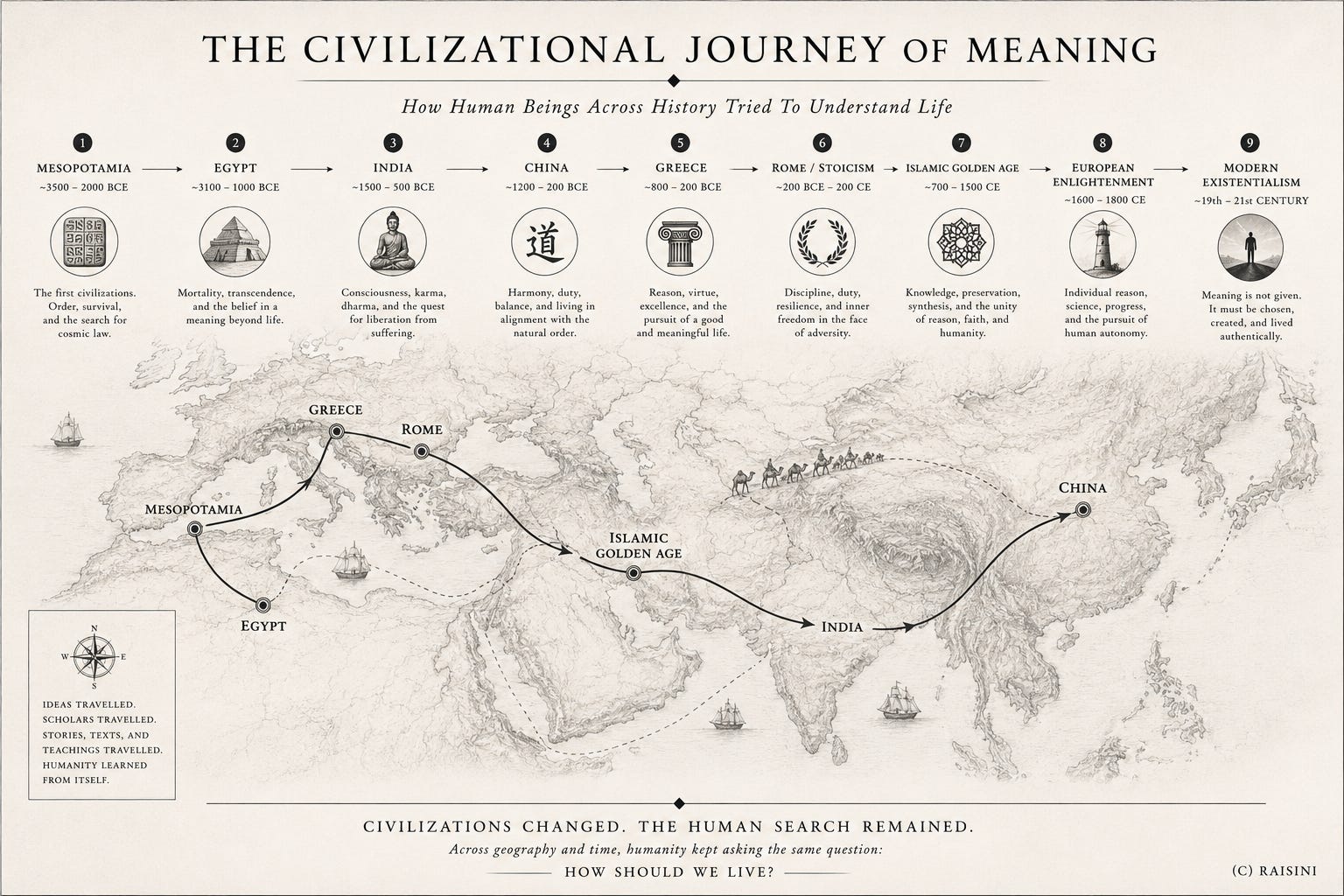
The ancient Greeks approached meaning primarily through virtue, discipline, excellence, and the cultivation of human potential over time. For Aristotle, fulfillment did not emerge through comfort or pleasure alone, but through what he described as the disciplined development of character, reason, and moral responsibility. A meaningful life required the active cultivation of courage, restraint, wisdom, and contribution across years of repeated behavior. Excellence was not viewed as talent people simply possessed naturally. It was viewed as practice. Identity itself was shaped through repeated action sustained long enough for character to solidify around it. The Greeks understood something many modern people still struggle to fully accept: humans are not transformed primarily through abstract intention, but through behavior repeated consistently over long periods of time.
The Stoics arrived at a related but distinct understanding of meaning. Thinkers such as Epictetus, Seneca, and Marcus Aurelius recognized that human suffering could never be eliminated entirely because uncertainty itself is built into existence. Life remains unstable, unpredictable, unfair, and partially outside human control regardless of historical period. Meaning therefore could not depend entirely upon external success or favorable conditions because those conditions inevitably change. Instead, Stoicism focused on internal order, self-mastery, discipline, restraint, responsibility, and the cultivation of character strong enough to withstand instability without psychological collapse. In many ways, Stoicism functioned as a form of psychological architecture for difficult civilizations. It taught individuals how to remain internally structured while living inside worlds they could not fully control. The reason Stoic philosophy continues resonating thousands of years later is not because Roman society survived unchanged, but because the underlying structure of human uncertainty never disappeared. Human beings still fear loss, rejection, suffering, instability, aging, and death exactly as they did in the ancient world. Civilization modernized. Human vulnerability largely did not.
In Buddhist traditions, the central problem underlying human existence was interpreted differently again. Buddhism recognized that much of human suffering emerges not merely from external hardship, but from attachment, craving, illusion, and the unstable relationship humans develop toward desire itself. People continuously pursue possessions, identities, pleasures, recognition, relationships, or future ambitions believing fulfillment permanently exists somewhere ahead of them, only to discover that satisfaction fades quickly once acquired. The mind immediately begins searching again. Meaning therefore became connected less to accumulation and more to awareness, compassion, balance, inner observation, and liberation from unconscious attachment. Long before modern psychology existed, Buddhist philosophy had already identified how unstable human happiness becomes when identity depends entirely upon external conditions remaining favorable indefinitely.
Other civilizations developed different language around similar structural realities. Confucian traditions emphasized harmony, ethical behavior, family obligation, hierarchy, education, and social responsibility because stable civilizations depended upon individuals capable of sustaining order across generations rather than pursuing only immediate personal gratification.
In Japanese traditions, particularly within samurai philosophy and later ideas surrounding Ikigai, meaning became connected to discipline, craftsmanship, mastery, contribution, and alignment between one’s abilities and responsibilities. Duty was not treated merely as external pressure imposed by society. It became part of identity itself. Even suffering could contain meaning when endured in service of something larger than immediate comfort.
Hindu philosophy introduced the concept of dharma, the idea that human beings possess obligations and roles connected to a larger moral and cosmic structure beyond individual desire alone. Purpose was therefore not viewed as random self-expression detached from reality, but as alignment between personal conduct, moral responsibility, and the structure of existence itself. Abrahamic traditions similarly grounded life in moral accountability, sacrifice, transcendence, service, and responsibility toward something greater than the self. Human beings were not interpreted merely as biological organisms pursuing survival and pleasure. Life carried ethical and spiritual significance connected to a larger order beyond individual appetite. Although these civilizations disagreed profoundly about theology, metaphysics, morality, and the structure of reality itself, many arrived repeatedly at similar conclusions regarding human psychology: people require orientation, responsibility, moral structure, and systems of meaning capable of organizing suffering into something psychologically tolerable.
What matters is not whether every civilization interpreted reality correctly in absolute terms. Human societies disagreed constantly across history about truth, morality, religion, metaphysics, and the nature of existence itself. What matters is that nearly every enduring civilization recognized the same underlying structural reality about human beings. People do not remain psychologically stable for very long in conditions where life appears entirely random, fragmented, meaningless, or directionless. Meaning systems helped civilizations organize sacrifice, regulate behavior, stabilize identity, justify moral frameworks, coordinate societies across generations, and provide explanations for suffering during periods of uncertainty. They answered questions modern societies often leave unresolved or attempt to outsource entirely to individual psychology. Why endure hardship? Why sacrifice for others? Why behave morally when morality becomes inconvenient? Why continue living during periods of suffering at all?
Human beings were never purely rational individuals independently constructing meaning from scratch. For most of history, people inherited explanatory systems before they were old enough to question those systems consciously. Religion, philosophy, tradition, family structures, tribe, duty, and collective narratives provided psychological orientation long before modern individualism emerged. The modern world weakened many of those inherited structures through secularization, technological acceleration, consumerism, globalization, and radical individual autonomy. But while modern societies dismantled older systems of meaning, they never fully replaced the psychological function those systems served. The need itself remained intact. Human beings still search for orientation, significance, belonging, responsibility, coherence, and direction exactly as they always have. The difference is that modern environments became significantly noisier, faster, more fragmented, and far more commercially driven than the civilizations preceding them.
Civilization removed many inherited answers while continuing to produce the same ancient questions. Which is partly why so many modern people feel psychologically adrift despite living inside the most materially advanced societies in human history. Progress solved many practical problems surrounding survival and comfort, but it did not eliminate the deeper existential problem human beings have wrestled with for thousands of years: how to construct a meaningful life inside reality once survival alone is no longer enough.
Why Modern People Feel Lost
Modern humans often assume that confusion is a personal failure.
If someone feels lost, unmotivated, disconnected, anxious, or uncertain about their direction, the assumption is usually that something inside them is broken. People blame themselves for lacking discipline, clarity, confidence, ambition, or emotional stability. But much of modern existential confusion is structural before it is personal. Human beings evolved in environments where identity, survival, social roles, and systems of meaning were far more stable and collectively reinforced than they are today. Modern life expanded freedom enormously, but it also dissolved many of the structures that previously helped people orient themselves psychologically. Humans gained more options while simultaneously losing many of the inherited frameworks that once explained how life was supposed to be lived.
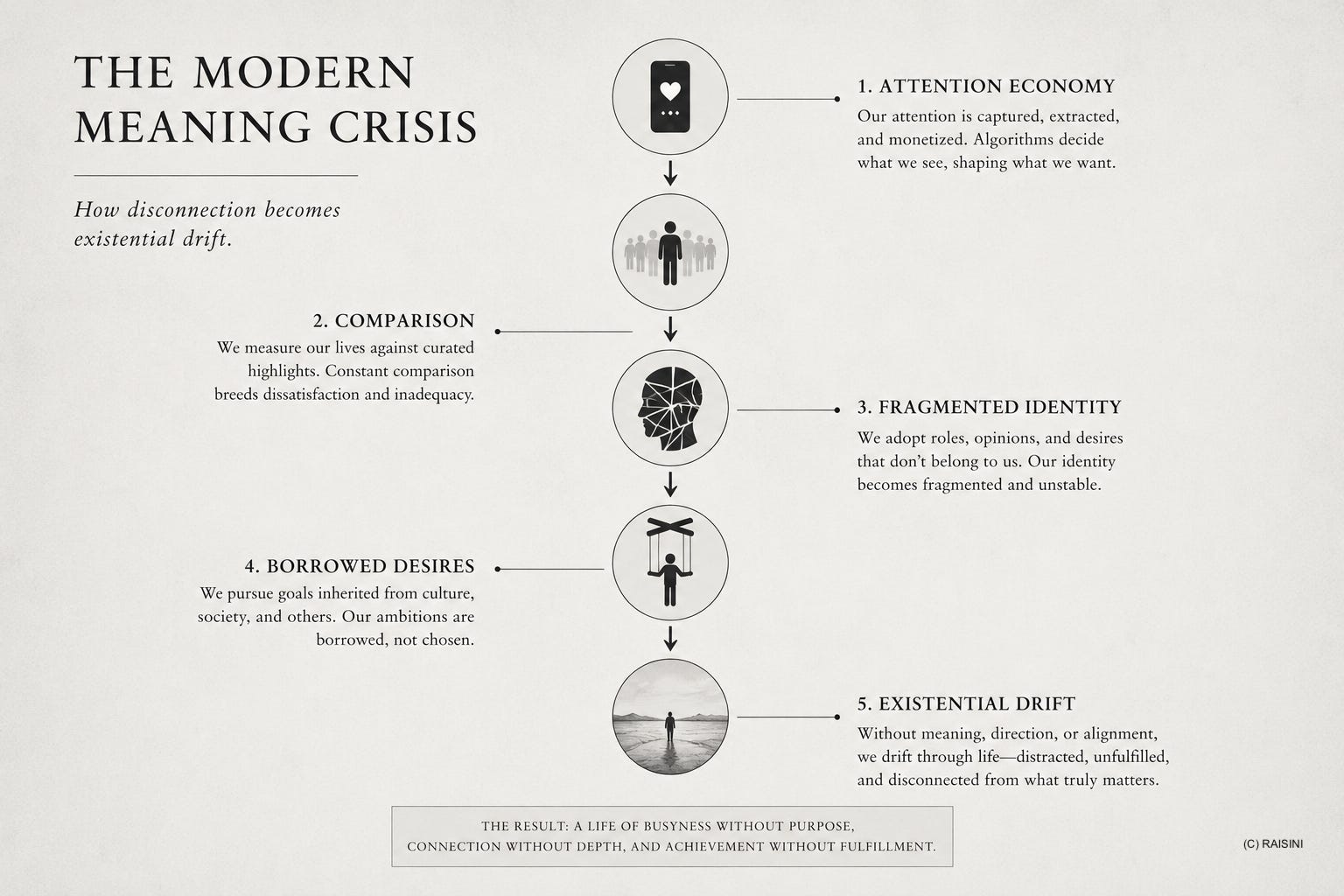
For most of human history, individuals inherited relatively clear identities and responsibilities. A person was born into a family structure, tribe, religion, trade, village, or social order that already carried expectations, obligations, values, and systems of meaning. Life was difficult, often brutally so, but psychologically simpler in one important sense: most people understood what their role inside the structure was supposed to be. Modernity altered that relationship completely. Industrialization, urbanization, globalization, technological acceleration, and digital connectivity expanded individual freedom on a scale almost no civilization had experienced before. Humans were no longer confined to one inherited identity or one predictable life path. In theory, this created liberation. In practice, it also created permanent uncertainty because freedom without orientation can easily become psychologically destabilizing.
The modern individual now faces an overwhelming number of possible identities, lifestyles, careers, ideologies, value systems, ambitions, and ways of living. Technology removed many external limitations, but it also removed much of the friction that once stabilized human decision-making. Previous generations often possessed fewer choices, but fewer choices can sometimes produce greater coherence because identity becomes narrower, more reinforced, and easier to sustain socially. Modern people are expected to construct an entire identity from scratch while navigating continuous comparison, constant stimulation, economic pressure, and digital environments that reward visibility more aggressively than reflection. The result is that many people spend years moving quickly without understanding where they are actually going or why the goals they pursue feel emotionally important to them in the first place.
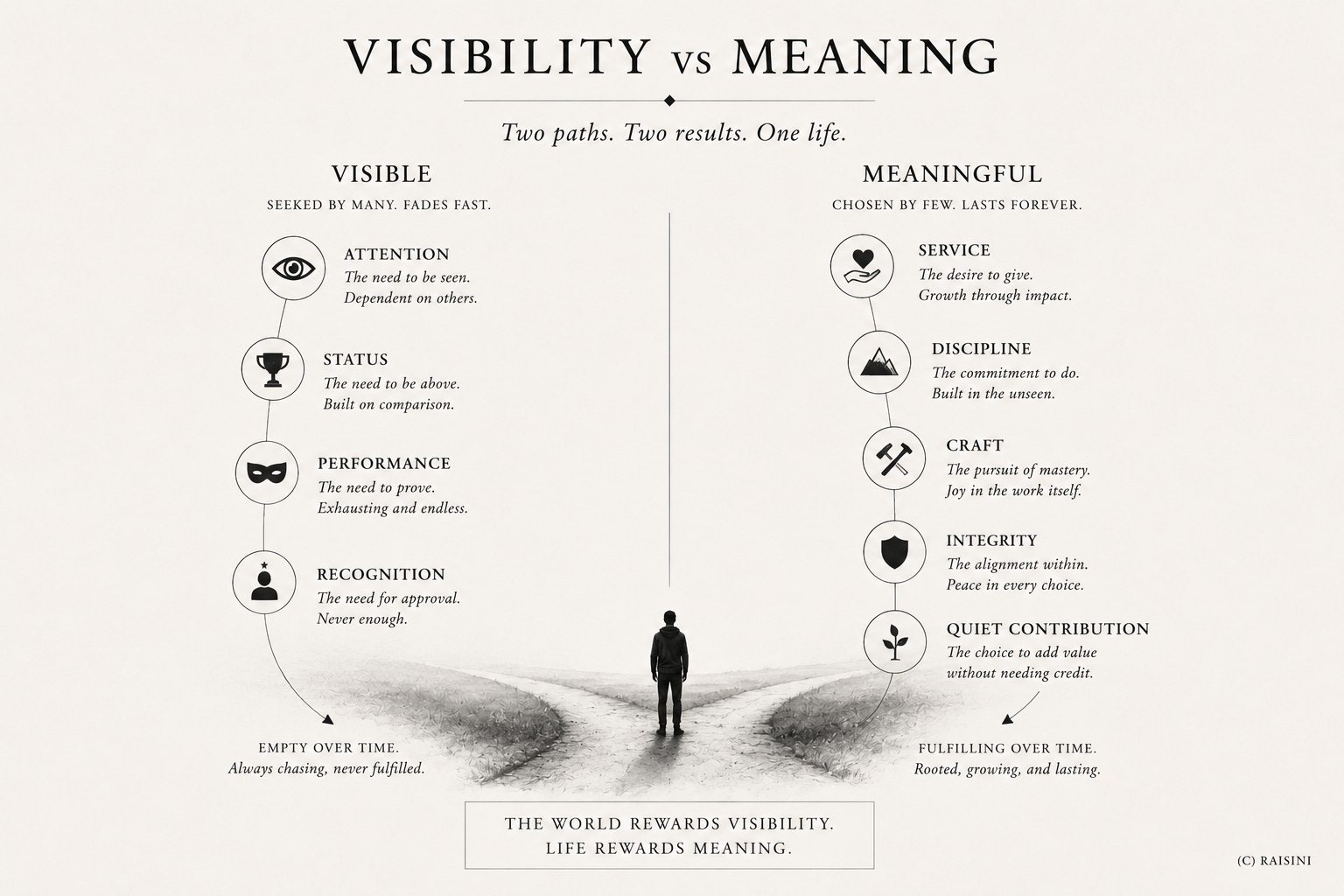
Social media intensified this condition dramatically because it industrialized comparison itself. Human beings are now exposed to millions of curated lives, status signals, aesthetics, lifestyles, ideologies, opinions, ambitions, and performances every single day. Previous civilizations compared themselves primarily to local communities and immediate social environments. Modern humans compare themselves to entire civilizations simultaneously. The human nervous system was never designed for this scale of exposure. As a result, many desires no longer emerge organically from lived experience, family values, local culture, or direct necessity. They are absorbed algorithmically through repeated exposure. People begin wanting things because visibility creates imitation. Status disguises itself as purpose. Consumption disguises itself as fulfillment. Visibility disguises itself as value. Entire identities gradually become shaped by external attention systems rather than by conscious internal examination.
This is where modern systems become psychologically dangerous in ways previous civilizations never encountered at comparable scale. The attention economy profits directly from instability because uncertain people consume more, compare more, scroll more, react more, and seek more external validation. Platforms are not designed primarily to help individuals develop coherent identities or meaningful lives. They are designed to maximize engagement because engagement produces revenue. Algorithms therefore reward emotional intensity, outrage, aspiration, insecurity, tribalism, controversy, novelty, and performance because these hold attention efficiently. Over time, this creates populations that are highly stimulated but internally fragmented. Many people no longer know whether their ambitions genuinely belong to them or whether those ambitions were socially inherited through continuous exposure to digital environments shaping perception beneath conscious awareness.
Thinkers like Donella Meadows understood that systems shape human behavior far more powerfully than individuals usually realize. Human beings often believe they are making fully independent decisions while operating inside environments specifically engineered to influence attention, incentives, habits, emotional responses, and perception itself. Similarly, Yuval Noah Harari explored how human societies organize themselves through shared narratives powerful enough to coordinate millions of strangers simultaneously. Modern humans still live inside collective stories, but many of those stories have become unstable, commercialized, fragmented, or contradictory. Meanwhile, thinkers like Erich Fromm warned that modern freedom often produces anxiety rather than peace because human beings simultaneously desire autonomy and psychological security. Freedom expands possibility, but it also expands uncertainty, responsibility, comparison, and internal pressure regarding how life should be lived.
This explains why so many people today feel strangely disconnected even while living inside materially advanced societies. They are not simply lacking ambition or discipline. Many are experiencing what could be described as orientation collapse. They inherited systems optimized for economic output, digital engagement, perpetual stimulation, and consumer activity, but not necessarily for existential clarity or psychological coherence. Modern life teaches people how to compete, produce, market themselves, survive financially, and remain economically functional. It rarely teaches them how to consciously construct meaning inside environments constantly competing to shape their attention externally.
Without conscious direction, human beings absorb goals from the environments surrounding them. They begin pursuing lifestyles before asking whether those lifestyles genuinely align with their nature. They pursue prestige without understanding why prestige feels emotionally necessary to them. They pursue wealth expecting it to resolve existential uncertainty, only to discover that financial success often removes survival anxiety without resolving deeper questions surrounding meaning, identity, and purpose. This is partly why many highly successful people still experience emptiness after achieving everything they once believed would complete them. External achievement can solve practical problems while leaving existential questions largely untouched.
Feeling lost, therefore, is often not evidence of individual weakness. It is the predictable psychological outcome of modern systems that expanded freedom, stimulation, and possibility faster than human beings evolved the ability to process them coherently. Humans are now attempting to answer ancient existential questions inside environments designed primarily for speed, consumption, stimulation, economic efficiency, and continuous distraction. And the more technologically advanced modern civilization becomes, the more important conscious meaning construction becomes for long-term psychological stability because inherited structures that once provided orientation automatically no longer exist with the same strength they once did.
Purpose Is Usually Built, Not Found
One of the biggest modern misconceptions about purpose is the belief that it arrives as a sudden revelation. People imagine there will be a moment where life becomes perfectly clear, where some internal voice finally announces what they were “meant” to do. Entire industries have formed around selling this fantasy. Humans search for purpose as though it were a hidden object waiting somewhere outside themselves, waiting to be discovered fully formed. But history suggests something very different. Most meaningful lives were not revealed instantly through certainty or emotional clarity. They were constructed gradually through action, responsibility, repetition, suffering, experimentation, failure, and long-term engagement with reality itself.
This matters because many people remain psychologically trapped while waiting for certainty before they begin moving forward. They believe clarity must arrive before action becomes possible. In reality, movement often creates clarity rather than the other way around. Human beings usually understand themselves far more accurately through lived experience than through endless abstraction or self-analysis alone. A person can spend years intellectually analyzing what career, identity, purpose, or direction they should pursue while learning surprisingly little about themselves in practice. Then six months of actually building something, teaching something, creating something, helping other people, carrying responsibility, failing publicly, or committing seriously to difficult work reveals more than a decade of isolated thinking ever could. Reality often teaches human beings who they are far faster than introspection alone.
The ancient Greeks understood this distinction clearly. Aristotle did not believe identity emerged primarily through internal feeling or abstract self-discovery. He believed character was built behaviorally through repeated action sustained over time. Human beings become courageous by acting courageously repeatedly. They become disciplined through disciplined behavior. They become trustworthy through practiced responsibility carried consistently across years. In other words, identity is not simply discovered internally waiting untouched beneath the surface. It is constructed gradually through repeated engagement with reality. Modern culture often reverses this process completely. Many people wait to “feel like themselves” before acting, when historically human beings often became themselves through action first.
This is also why suffering plays a far greater role in purpose formation than modern culture usually wants to admit. Human beings rarely develop deep meaning during periods of comfort alone. Some of the clearest forms of internal orientation emerge through difficulty, sacrifice, grief, uncertainty, responsibility, prolonged struggle, or confrontation with limitation itself. Viktor Frankl observed this while surviving concentration camps during the Second World War. Frankl noticed that human beings could endure extraordinary suffering when that suffering remained connected to meaning. The mind deteriorates much faster when pain appears random, directionless, or empty because suffering without meaning becomes psychologically difficult to organize internally. Purpose gives suffering structure. It transforms hardship from meaningless pain into something psychologically survivable.
This pattern appears repeatedly across civilizations because human beings have always struggled with uncertainty, instability, suffering, and the search for direction. Epictetus taught that individuals cannot fully control external events, but they can shape the character with which they respond to them. Seneca repeatedly warned against drifting passively through life without conscious direction or self-examination. Japanese philosophy surrounding Ikigai similarly approached purpose less as fantasy and more as alignment between usefulness, ability, contribution, discipline, and meaningful engagement with everyday life. None of these traditions treated purpose as instant emotional certainty or mystical revelation. They understood it as something refined slowly through participation in reality itself.
Modern people often struggle with this process because they have become psychologically overexposed to infinite possibility. Endless options frequently create paralysis rather than freedom. Someone attempting to evaluate ten possible futures simultaneously often struggles more than someone fully committed to building one imperfect path consistently over time. The modern mind constantly fears choosing incorrectly because modern culture increasingly treats every decision as permanent identity definition. But purpose rarely appears fully formed in advance. Human beings usually recognize meaning retrospectively. Looking backward, patterns become visible. Certain forms of work consistently energized them. Certain responsibilities deepened them psychologically. Certain struggles felt painful but meaningful rather than empty. Certain forms of contribution created a sense of internal coherence difficult to replicate through pleasure, entertainment, or temporary achievement alone.
This is why action creates clarity more reliably than endless introspection. Reflection matters. Self-awareness matters. Careful thinking matters. But excessive self-analysis without engagement eventually becomes another form of psychological stagnation because some people become trapped studying life instead of participating in it. They attempt to solve purpose intellectually while remaining detached from the experiences capable of generating it. Human beings are adaptive creatures. Meaning often emerges only after prolonged interaction with challenge, repetition, responsibility, uncertainty, failure, contribution, and sustained effort directed toward something outside immediate self-interest.
There is also something psychologically stabilizing about commitment itself. When human beings commit seriously to building something over long periods of time, identity gradually organizes around that commitment. A teacher becomes shaped by years of teaching. A parent becomes shaped by protecting and guiding children through responsibility carried daily. An artist becomes shaped through creation repeated consistently over years, often long before recognition arrives. A writer becomes shaped through observation, reflection, articulation, and sustained attention toward reality itself. Purpose deepens through prolonged engagement because repetition transforms abstract interest into lived structure. Human beings become attached not only to outcomes, but also to the process through which meaning itself is constructed gradually over time.
The dangerous fantasy is believing purpose should arrive fully formed before effort begins. History repeatedly suggests the opposite. Most meaningful lives were built gradually, often uncertainly, by individuals moving forward long before possessing complete clarity about where they would eventually arrive. The modern obsession with certainty frequently delays the very experiences capable of producing meaning in the first place because people remain psychologically frozen while waiting for guarantees reality was never designed to provide.
Human beings do not think their way into purpose entirely. They build their way into it through sustained participation in life itself.
Borrowed Ambition and Chosen Meaning
One of the most difficult parts of finding purpose is realizing how much of human identity is inherited long before it is consciously chosen. Most people do not begin life by independently deciding what success, meaning, morality, ambition, fulfillment, or status should look like. They absorb these definitions gradually from the systems surrounding them. Family structures, schools, religion, culture, institutions, economic pressures, peer groups, media environments, algorithms, and social expectations all shape human desire long before most individuals develop enough self-awareness to question those influences consciously. By the time many people begin seriously examining their lives, large portions of their ambitions, fears, preferences, and definitions of success were already psychologically installed through years of repetition and environmental reinforcement.
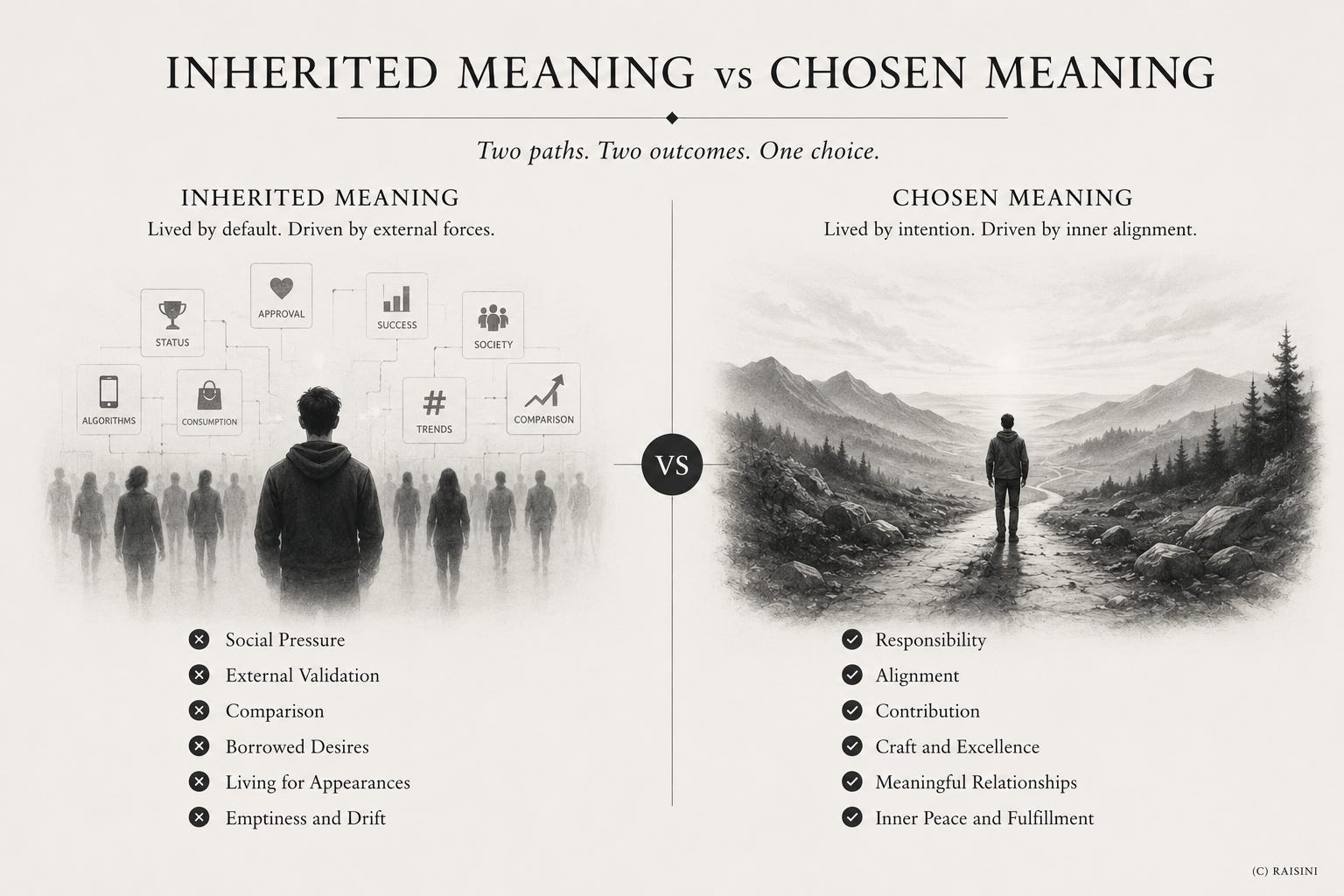
This is not necessarily malicious. Human beings are social creatures, and societies cannot function if every generation starts psychologically from zero. Civilizations transmit values, ambitions, behavioral norms, moral expectations, and systems of meaning because continuity depends upon it. Every society, whether ancient or modern, attempts to shape individuals into forms compatible with its own survival and stability. The problem emerges when inherited goals remain entirely unconscious for decades. Many people spend enormous portions of their lives pursuing paths they never consciously evaluated for themselves. They pursue certain careers because prestige signals security. They pursue wealth because modern culture increasingly associates financial success with personal worth. They pursue visibility because attention has become one of the most rewarded currencies within digital environments. Over time, being seen begins to feel psychologically synonymous with being valuable.
This creates a dangerous form of psychological substitution that many people never fully recognize while living inside it. Approval gradually disguises itself as fulfillment. Prestige disguises itself as alignment. External success disguises itself as meaning. A person can achieve nearly every socially rewarded milestone while remaining internally disconnected from the life they are actually living. The external structure may appear successful, disciplined, admired, or impressive while the internal structure remains psychologically unanchored. This helps explain why existential emptiness frequently appears even among highly accomplished individuals. Material success can solve practical problems extremely effectively while leaving deeper questions surrounding meaning, identity, and purpose almost entirely unresolved.
Modern systems intensify this condition dramatically because human beings now absorb desires continuously through digital exposure rather than primarily through local environments. Previous civilizations inherited systems of meaning largely from family structures, religion, tribe, profession, local culture, and relatively stable institutions. Modern individuals inherit desires algorithmically from millions of strangers simultaneously. Social media does not simply expose people to products, lifestyles, or entertainment. It shapes aspiration itself. It continuously trains attention toward particular forms of beauty, status, wealth, influence, identity, politics, success, and social validation. Over time, many people begin pursuing goals not because those goals emerged organically from their own nature, but because repeated exposure normalized those ambitions psychologically until imitation began feeling indistinguishable from authentic desire.
This is partly what Friedrich Nietzsche warned about when discussing herd mentality, conformity, and inherited morality. Nietzsche understood that human beings often inherit values collectively without deeply examining whether those values genuinely align with their own nature. Social conformity provides psychological safety because belonging has always been deeply connected to human survival. Throughout most of history, exclusion from the tribe often carried severe consequences. But conformity also creates unconscious imitation because people naturally internalize the behaviors rewarded by the environments surrounding them. Individuals frequently pursue lives optimized for social approval rather than internal coherence because approval produces immediate emotional reinforcement while existential misalignment often develops slowly and quietly over time.
The difficulty is that externally inherited ambitions can sometimes produce material success while simultaneously weakening psychological stability underneath the surface. Someone may spend twenty years pursuing prestige only to discover that prestige cannot answer deeper questions surrounding meaning. Another person may construct an entire identity around admiration, only to experience psychological collapse once validation disappears or external attention fades. Human beings can tolerate surprisingly difficult conditions when their suffering feels connected to consciously chosen meaning. But suffering attached to unconscious imitation often produces resentment, exhaustion, emotional fragmentation, and eventually burnout because the individual no longer understands why the sacrifice feels necessary in the first place.
This is why purpose requires a deeper form of honesty than modern culture usually encourages. The real questions are often quieter and more uncomfortable than people expect. What type of suffering feels meaningful to you personally rather than merely socially rewarded? What forms of work naturally hold your attention even when external rewards become inconsistent? What responsibilities would you willingly continue carrying despite difficulty, uncertainty, or lack of recognition? What remains meaningful when applause, visibility, prestige, or external validation disappear entirely? These questions matter because purpose often reveals itself indirectly through patterns of sustained attention, voluntary responsibility, and repeated forms of effort human beings continue returning toward almost instinctively.
Meaning frequently leaves behavioral evidence before it becomes intellectually articulated clearly. Certain forms of contribution create energy rather than depletion. Certain responsibilities deepen identity rather than weakening it. Certain struggles feel painful but meaningful instead of empty. Human beings often discover purpose less through abstract philosophical revelation and more through observing which forms of effort create internal coherence over long periods of time. Looking backward, patterns gradually become visible. Certain forms of work repeatedly mattered to them. Certain problems consistently held emotional significance. Certain responsibilities organized life psychologically rather than fragmenting it.
This also explains why many people remain confused for years while technically succeeding according to external standards. They continue optimizing inherited ambitions without fully examining whether those ambitions genuinely belong to them. Modern systems encourage constant movement because movement sustains economic productivity and psychological stimulation, but movement alone does not guarantee alignment. A person can move very quickly in the wrong direction for a very long time. Busyness often disguises existential avoidance because constant activity prevents individuals from confronting whether the life they are building actually feels psychologically coherent beneath the surface.
Eventually, however, many people encounter moments where inherited meaning begins to fracture. Sometimes this happens through grief, aging, failure, illness, burnout, parenthood, success, disappointment, or simple exhaustion from performing identities that no longer feel psychologically sustainable. The structures that once organized life stop feeling emotionally convincing. This can initially feel destabilizing because old systems of meaning are collapsing before new ones have fully formed. But these periods often become the beginning of conscious reconstruction. Human beings cannot build authentic meaning while remaining entirely unconscious of the systems shaping their desires, fears, ambitions, and definitions of success.
Chosen meaning does not require rejecting society completely or isolating oneself from civilization. Human beings will always exist inside systems, cultures, institutions, and collective structures larger than themselves. The goal is not rebellion for its own sake. The goal is awareness. Mature purpose emerges when individuals begin consciously deciding which values, responsibilities, forms of contribution, and ways of living genuinely align with their nature instead of merely inheriting them passively from the environment surrounding them. Purpose becomes significantly more stable once it is consciously chosen rather than unconsciously absorbed because meaning rooted in awareness tends to survive external instability far more effectively than meaning rooted entirely in social imitation.
Responsibility Is What Stabilizes Meaning
Modern culture often frames purpose as a deeply personal pursuit centered around happiness, self-expression, fulfillment, freedom, or emotional satisfaction. While those things matter, history suggests that meaning rarely stabilizes through self-focus alone. Human beings tend to find deeper and more durable purpose when their lives become connected to responsibility beyond themselves. This is one of the oldest patterns visible across civilizations. People become psychologically stronger not merely when they pursue pleasure, but when they become useful, reliable, protective, creative, disciplined, and necessary to something larger than their immediate desires. Responsibility gives human life structure because it forces individuals to organize themselves around continuity rather than temporary emotional fluctuation.
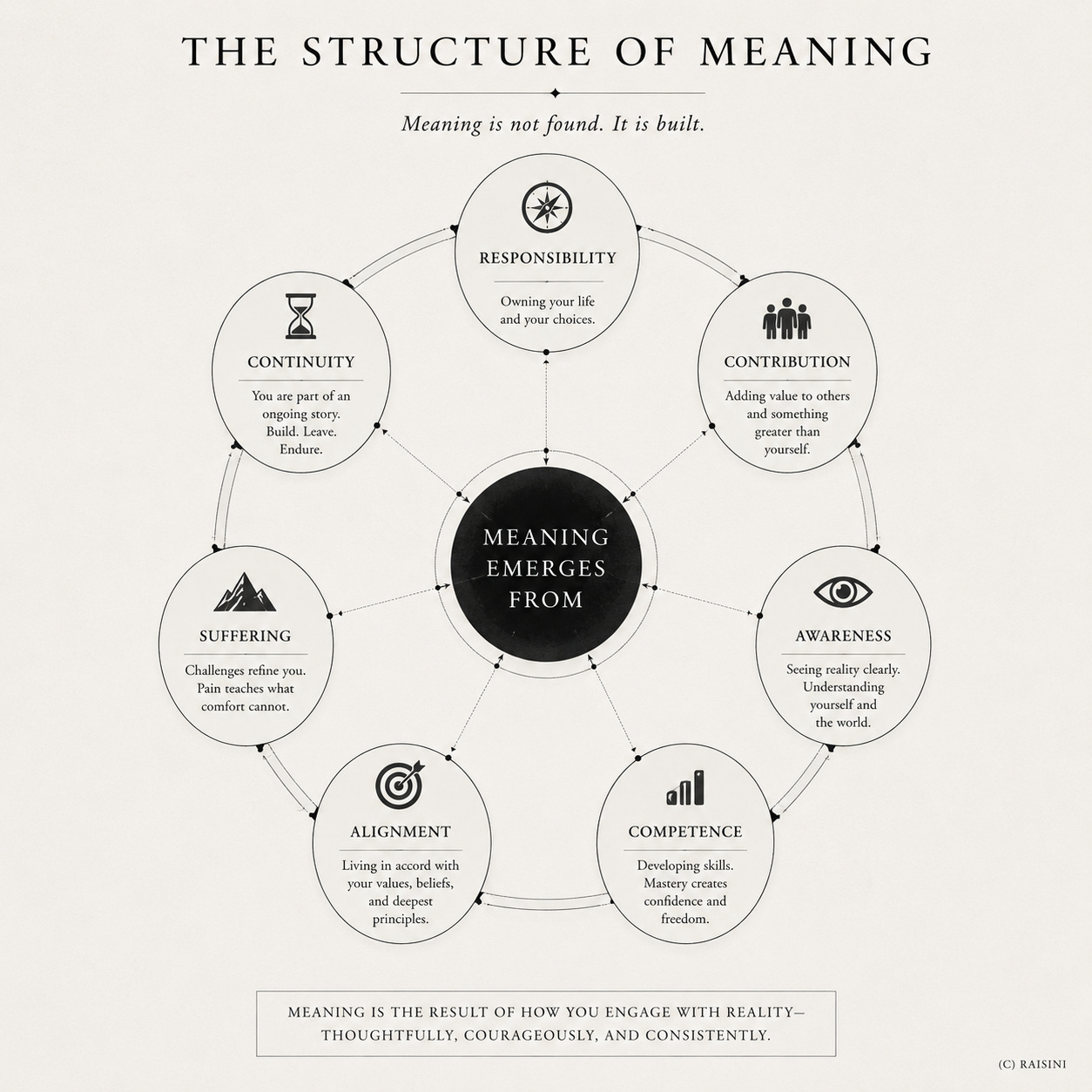
This changes the structure of human existence in important ways. A person responsible only for their own short-term emotional state often becomes psychologically unstable because emotions fluctuate constantly. Motivation rises and falls. Confidence changes. Pleasure adapts quickly. But responsibility forces individuals to continue acting beyond temporary moods. A parent still protects their child while exhausted. A teacher still teaches while uncertain. A builder still builds while struggling privately. A doctor still treats patients while carrying grief invisible to the people around them. Responsibility anchors action to something more durable than emotional convenience. It creates continuity between present behavior and future consequence, which gradually stabilizes identity over time.
This is partly why so many ancient philosophical systems treated duty as psychologically important rather than merely morally admirable. Marcus Aurelius repeatedly wrote about the importance of fulfilling one’s role within the larger structure of existence regardless of external chaos or personal discomfort. Stoicism never promised permanent happiness or emotional ease. It focused more on character, contribution, discipline, restraint, and responsibility under conditions human beings cannot fully control. Similarly, Confucian traditions emphasized harmony, obligation, family responsibility, education, and social order because civilizations understood that societies deteriorate when individuals abandon responsibility entirely in pursuit of unrestricted personal desire. Ancient cultures repeatedly recognized something modern societies often resist admitting openly: freedom without responsibility frequently produces fragmentation rather than fulfillment.
Modern culture sometimes treats responsibility primarily as limitation or burden, but psychologically it often functions as orientation. Human beings deteriorate when they feel unnecessary for prolonged periods of time. A person who believes nobody depends on them, values their contribution, benefits from their existence, or genuinely needs them often experiences deep existential instability beneath the surface. Humans are relational creatures. Meaning deepens when actions visibly affect other people, future outcomes, communities, knowledge, family structures, creative work, or forms of contribution capable of extending beyond the self. Responsibility expands identity outward. It connects individuals to continuity larger than immediate personal gratification.
This is also why contribution matters so deeply to human psychology. Many people initially pursue purpose through pleasure, entertainment, consumption, comfort, or status accumulation only to discover these provide temporary stimulation rather than durable meaning. The human mind adapts quickly to comfort. Pleasure normalizes. Consumption escalates. External rewards lose emotional intensity over time because humans psychologically acclimate to improved conditions surprisingly fast. Contribution operates differently because it connects identity to usefulness rather than passive gratification. Human beings often experience deeper fulfillment from building, protecting, teaching, mentoring, solving problems, creating, guiding, or carrying burdens competently than from comfort alone because contribution reinforces the feeling that one’s existence produces meaningful effects within reality itself.
Viktor Frankl understood this profoundly. Frankl believed meaning often emerges through responsibility toward life itself. Even under catastrophic conditions, human beings psychologically survive longer when they remain connected to responsibility, whether toward loved ones, unfinished work, moral duty, spiritual conviction, or future contribution. Meaning stabilizes suffering because responsibility gives suffering direction. Pain becomes psychologically far more difficult to tolerate when it appears random, detached, or existentially empty. Human beings can endure extraordinary hardship when they understand what the hardship is being endured for.
There is also an important structural reason responsibility stabilizes identity over long periods of time. Human beings construct themselves gradually through repeated commitments sustained consistently across years. A meaningful life is rarely built through isolated emotional highs, temporary inspiration, or occasional moments of motivation. It is built through continuity. Someone who writes consistently for years slowly becomes a writer psychologically because identity organizes itself around repeated action. Someone who protects and provides for family develops character through sustained responsibility carried daily across time. Someone who teaches develops meaning through long-term contribution toward other minds. Responsibility transforms abstract values into lived structure because repetition slowly converts intention into identity.
This is why purpose is often less about what makes someone temporarily happy and more about what they are willing to continue carrying consistently despite difficulty, uncertainty, boredom, sacrifice, or adversity. Many things create excitement initially. Far fewer things survive prolonged contact with reality. But the responsibilities human beings willingly continue carrying despite hardship often reveal something important about where deeper meaning exists for them. Meaning tends to become visible not only through pleasure, but through endurance. Human beings frequently discover purpose by observing which burdens they remain willing to carry voluntarily even when easier alternatives remain available.
The modern world increasingly encourages endless self-focus disguised as self-discovery. Human beings are encouraged to constantly optimize themselves, market themselves, express themselves, analyze themselves, compare themselves, and prioritize personal satisfaction above almost everything else. But excessive self-focus often increases existential instability rather than resolving it because attention turned inward indefinitely can become psychologically corrosive. A person endlessly evaluating whether they feel fulfilled, validated, recognized, successful, admired, or emotionally satisfied often becomes trapped inside permanent self-monitoring. Responsibility interrupts that cycle by redirecting attention outward toward usefulness, contribution, continuity, and service. Paradoxically, human beings often become psychologically stronger when they stop organizing life entirely around themselves.
This does not mean individuals should sacrifice themselves blindly for systems, institutions, expectations, or responsibilities that destroy them psychologically. Responsibility without alignment eventually becomes resentment, exhaustion, emotional numbness, or quiet despair. But when responsibility becomes connected to consciously chosen values, meaningful contribution, and genuine internal alignment, it becomes one of the strongest foundations for durable purpose human beings can build their lives upon. Meaning becomes significantly more stable once it survives contact with responsibility because purpose only becomes real when it continues existing beyond comfort, mood, convenience, or temporary emotional intensity.
Why Awareness Complicates Purpose
One of the paradoxes of awareness is that clarity does not immediately create peace. In many cases, it destabilizes the very structures that once made life feel coherent. Human beings often assume that seeing reality more clearly will automatically improve their lives, but awareness frequently creates disruption before it creates stability. This happens because much of human identity depends on inherited narratives operating quietly beneath conscious thought. People rely upon assumptions about success, morality, ambition, relationships, politics, status, religion, identity, and social belonging long before they critically examine where those assumptions originated from. Awareness begins dissolving those inherited structures, and once that process starts, many things that previously felt emotionally convincing no longer hold the same psychological authority over the individual.
This is partly why periods of intellectual, philosophical, or psychological awakening often feel emotionally disorienting rather than immediately liberating. A person gradually begins noticing contradictions they previously ignored. Certain ambitions stop feeling authentic. Certain social rituals begin feeling performative. Entire systems that once appeared natural start revealing themselves as constructed environments shaped by incentives, power structures, collective conditioning, economic pressure, emotional insecurity, or historical circumstance. The individual starts seeing how much human behavior is influenced by status signaling, imitation, fear of exclusion, social reinforcement, and unconscious adaptation to surrounding systems. This awareness can create distance not only from institutions, ideologies, and collective narratives, but sometimes from other people and even from previous versions of oneself.
The difficulty is that human beings cannot simply remove meaning structures without psychological consequences. Identity depends heavily upon orientation. Once inherited narratives begin collapsing, individuals often experience a temporary vacuum where previous motivations no longer feel emotionally convincing, yet new forms of meaning have not been consciously constructed strongly enough to replace them. This is where many intelligent or highly self-aware individuals become psychologically trapped. They successfully deconstruct old systems of meaning but fail to reconstruct stable internal frameworks afterward. They become highly skilled at identifying illusion while gradually losing confidence in their ability to orient themselves meaningfully inside reality itself.
Modern culture unintentionally intensifies this condition because it increasingly rewards critique more than reconstruction. It is easier to dismantle belief systems than to build sustainable alternatives capable of organizing human life coherently afterward. Social media especially amplifies skepticism, irony, cynicism, permanent analysis, and institutional distrust because these forms of thinking spread efficiently inside attention economies. Entire generations became highly skilled at identifying hypocrisy, manipulation, performative morality, political corruption, institutional failure, and social illusion. But recognizing flaws alone does not create meaning. Human beings still require orientation afterward. A person can intellectually dismantle nearly every inherited structure in their life while remaining emotionally incapable of constructing anything durable enough to replace it.
This is where awareness can become psychologically dangerous when it develops without proportion or grounding. Excessive analysis often weakens action because the individual becomes so conscious of complexity, contradiction, uncertainty, manipulation, and incompleteness that decision-making itself begins collapsing beneath the weight of interpretation. Every ambition appears socially conditioned. Every institution appears flawed. Every ideology appears partially compromised. Every system reveals incentives operating beneath the surface. Eventually, the individual risks becoming trapped in permanent observation instead of participation. Awareness then stops functioning as clarity and slowly transforms into paralysis because the person no longer trusts any structure enough to commit themselves fully to it.
This tension has existed throughout philosophy for centuries because greater freedom almost always increases uncertainty simultaneously. Once human beings stop inheriting unquestioned identities automatically, they become responsible for constructing meaning consciously themselves. Intellectually, this sounds liberating. Psychologically, it can feel overwhelming because humans often underestimate how much stability inherited structures previously provided. Religion, family systems, tradition, communities, social roles, moral frameworks, and collective narratives may have contained limitations, contradictions, and forms of control, but they also reduced existential chaos by organizing identity, behavior, values, and responsibility into psychologically understandable structures. Human beings no longer had to consciously reconstruct meaning from zero because much of that orientation was inherited automatically.
The modern individual now faces a far more difficult task. They are expected to critically evaluate inherited systems while simultaneously constructing stable meaning independently inside environments filled with constant stimulation, distraction, ideological conflict, commercial influence, and informational overload. Many people successfully complete the first half of that process but never fully complete the second. They detach from old narratives without consciously building new frameworks strong enough to stabilize them afterward. This often produces a strange combination of intelligence and emptiness. The person sees through illusion clearly, but no longer knows what should replace it or what form of meaning deserves commitment once certainty disappears.
This is why awareness alone is insufficient for building a meaningful life. Clarity matters enormously, but human beings still require structure, responsibility, values, contribution, continuity, and long-term orientation afterward. The collapse of illusion is only the first phase. A stable life still requires meaning systems capable of organizing action and identity, even if those systems become consciously chosen rather than unconsciously inherited. Human beings still need reasons to act, build, protect, create, love, contribute, sacrifice, and endure difficulty despite understanding complexity more deeply than before.
Mature awareness therefore is not endless deconstruction. It is reconstruction with consciousness. It is learning how to see systems clearly without becoming consumed by permanent detachment from reality itself. Human beings still require psychological grounding after illusion weakens. Without that reconstruction phase, awareness eventually turns inward destructively because the individual loses orientation without replacing it with anything durable enough to sustain meaning over time.
The goal is not returning to unconscious illusion. The goal is learning how to remain psychologically grounded after illusion disappears while continuing to participate meaningfully in reality despite understanding its imperfections more clearly than before.
Building Meaning Inside Modern Reality
One of the biggest mistakes modern culture makes is treating purpose as a hidden treasure waiting to be discovered somewhere deep inside the self, as though one perfect realization will suddenly organize an entire life permanently. In reality, meaning is usually constructed through repeated interaction with reality itself.
Human beings build purpose the same way civilizations build stability: gradually, imperfectly, through continuous adjustment across time. This matters because many people remain psychologically frozen while waiting for certainty before they begin living seriously. They believe they must fully understand themselves before movement becomes possible. But life rarely unfolds in that order. Most clarity arrives after engagement rather than before it. Human beings understand themselves through action far more reliably than through endless self-analysis detached from lived experience. Unfortunately, modern systems increasingly encourage the opposite pattern. People spend years consuming information, comparing identities, studying lifestyles, optimizing appearances, curating personalities, and imagining future versions of themselves without committing deeply enough to anything for meaning to emerge organically. The result is a generation highly stimulated intellectually but often structurally disconnected from purpose itself. The mind keeps searching while the life remains stationary. Civilization invented infinite scrolling before it solved existential direction. A remarkable species, truly.
One of the first steps toward building meaning inside modern reality is reducing enough external noise to observe your own patterns clearly. Modern environments constantly shape identity through comparison, algorithms, advertising, digital exposure, social imitation, and attention competition. Most people underestimate how much of their thinking has been externally influenced long before it feels personally chosen. Desires are often absorbed socially before they are consciously examined critically. Social media intensified this process because individuals are now exposed to thousands of competing lifestyles, ambitions, values, aesthetics, ideologies, and performances every single week. Over time, this creates psychological fragmentation because people begin chasing identities rather than building coherent lives. They pursue visibility instead of alignment. They imitate what appears valuable rather than examining what genuinely creates internal stability over long periods of time. This is partly why silence, reflection, solitude, contemplation, and temporary withdrawal from external noise mattered across so many philosophical and spiritual traditions throughout history. Whether through Buddhist meditation, Stoic reflection, monastic retreat, religious isolation, or simple periods away from collective distraction, human beings repeatedly discovered that clarity becomes increasingly difficult once the mind is permanently overwhelmed by external signals competing for attention. A person who never disconnects from collective influence eventually loses the ability to distinguish between genuine purpose and socially inherited desire.
Once external noise decreases sufficiently, patterns gradually begin revealing themselves. Purpose rarely arrives through dramatic revelation or sudden certainty. More often, meaning emerges quietly through recurring forms of attention sustained across time. Certain problems continue pulling an individual back repeatedly. Certain forms of work hold concentration longer than others. Some responsibilities consistently drain energy while others create energy despite difficulty, sacrifice, or uncertainty. Across years, these patterns matter far more than temporary emotion because human beings often discover meaning indirectly by observing what consistently survives friction. What are you still drawn toward after disappointment, boredom, failure, criticism, or exhaustion? What type of effort remains psychologically sustainable even when external rewards become inconsistent? What responsibilities would you continue carrying voluntarily even if recognition disappeared entirely? These questions matter because purpose often hides inside repeated attention rather than intense emotional excitement. Modern culture increasingly conditions people to associate meaning with passion, intensity, visibility, or constant inspiration, but many meaningful lives are built through quiet sustained contribution rather than dramatic emotional certainty.
Contribution itself becomes another essential layer in the construction of meaning. Human beings derive purpose not only from self-expression, but from usefulness. Across history, meaning deepened when individuals understood that their existence genuinely improved something beyond themselves. This does not necessarily mean changing the world at enormous scale. Modern culture frequently distorts purpose by attaching it to visibility, influence, and mass recognition. In reality, many meaningful lives are structurally small but psychologically profound. Raising children responsibly. Protecting family. Preserving knowledge. Building something honest. Helping other people think more clearly. Teaching with integrity. Carrying responsibility competently. Creating stability where disorder previously existed. These forms of contribution rarely dominate headlines, yet civilizations depend upon them continuously. Modern systems often glorify attention while underestimating usefulness. But human beings psychologically deteriorate when they feel unnecessary for too long because meaning deepens once a person understands their existence genuinely reduces suffering, improves reality, strengthens others, or contributes stability in some tangible way. Purpose becomes significantly more durable once it extends beyond personal consumption alone.
Competence also matters far more deeply to human meaning than many people initially realize. Purpose strengthens when ability strengthens because competence creates visible evidence that effort produces consequence inside reality. This is partly why meaningless work becomes psychologically corrosive over long periods of time. When individuals cannot clearly observe the relationship between effort, growth, usefulness, and outcome, motivation gradually collapses. But when a person improves steadily at something meaningful, identity begins stabilizing naturally around that development. Confidence becomes quieter and less performative because it is grounded in lived capability rather than external validation. This principle appears repeatedly throughout history. Aristotle spoke about excellence emerging through repeated action rather than abstract intention alone. Japanese craftsmanship traditions emphasized disciplined refinement sustained across decades. Stoicism valued character built through practice rather than philosophical theory disconnected from life. Even modern systems thinking recognizes that small repeated behaviors compound gradually into larger structural outcomes over time. Meaning frequently emerges through sustained engagement with reality rather than through abstract philosophical certainty detached from practice.
At the same time, mature purpose requires accepting uncertainty rather than attempting to eliminate it entirely. No civilization, religion, philosophy, ideology, or intellectual system has ever fully solved existence because reality remains partially unknowable regardless of historical period. The modern world often pressures people into believing they must fully define themselves early, permanently, and publicly. But human beings evolve continuously through experience, suffering, relationships, failure, aging, responsibility, reflection, and time itself. Purpose is therefore less like a final destination and more like an ongoing relationship between the self and reality. Some individuals become psychologically paralyzed because they search for absolute certainty before committing seriously to any direction. But certainty rarely arrives in advance. Meaning is often recognized retrospectively after years of engagement. Most people who eventually built meaningful lives did not begin with complete understanding. They began with movement, responsibility, curiosity, discipline, endurance, and sustained participation in life itself. Clarity gradually emerged while living. Which is considerably less cinematic than modern self-help culture promises, but substantially more consistent with how human beings have historically constructed meaning across time.
Ultimately, a meaningful life is not built by escaping uncertainty, eliminating struggle, perfectly understanding existence, or discovering some hidden permanent identity buried beneath experience. It is built through conscious participation in reality despite uncertainty remaining unavoidable. Through sustained attention. Through contribution. Through competence. Through responsibility. Through alignment between values and behavior carried consistently across years. Purpose is not something automatically handed to human beings by the universe fully formed. It is something shaped gradually through the decisions, obligations, sacrifices, disciplines, relationships, and patterns a person repeatedly chooses to carry over long periods of time. Meaning becomes durable once it survives contact with reality rather than remaining trapped at the level of imagination alone.
Purpose Changes As Human Beings Change
One of the reasons many people remain confused about purpose is because they unconsciously treat it as something fixed, singular, and permanent. Modern culture often presents purpose almost like a final destination: one perfect identity, one ultimate calling, one fully defined path capable of organizing an entire life forever. But human beings do not remain psychologically static across decades, and meaning rarely remains static either. The purpose that organizes a person at twenty is often very different from the purpose that organizes them at forty, sixty, or eighty because human beings themselves change continuously through experience, suffering, responsibility, aging, relationships, success, failure, grief, and time.
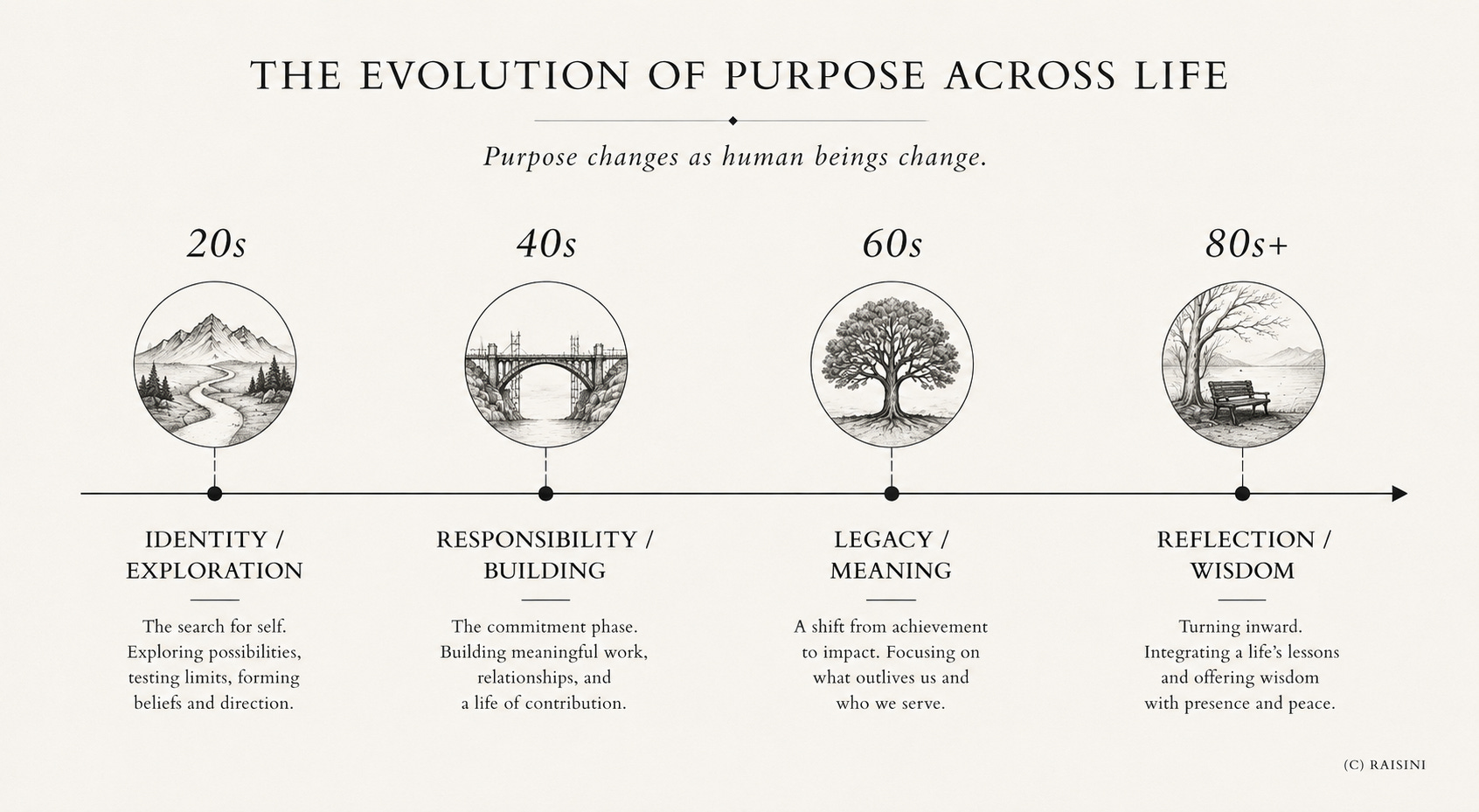
This becomes easier to understand once purpose is viewed less as a single permanent answer and more as an evolving relationship between the self and reality. A young person often searches for identity, independence, capability, direction, exploration, and the feeling that their life is beginning to move somewhere meaningful. At that stage, purpose may revolve around experimentation, ambition, skill development, creation, movement, and discovering what kind of life feels psychologically alive to them. The struggle is often less about wisdom and more about orientation. Younger people frequently experience existential anxiety because they feel pressured to define themselves permanently before they have accumulated enough lived experience to understand themselves clearly in the first place.
As people grow older, the structure of meaning often changes. Responsibility gradually replaces exploration as a stabilizing force. A person who once focused primarily on personal ambition may begin organizing life around family, contribution, protection, mentorship, craftsmanship, leadership, or long-term creation. Meaning deepens because identity expands beyond the self. The individual begins understanding that purpose is not simply about personal expression or emotional fulfillment, but also about becoming someone capable of carrying weight reliably for other people. This is one reason many individuals become psychologically more grounded as they age despite external life becoming more complex. Responsibility forces identity into contact with reality repeatedly over long periods of time.
Later in life, meaning often transforms again. Ambition itself may lose some of the emotional intensity it once carried because people begin recognizing how temporary many forms of status, recognition, and accumulation actually are. The pursuit that once felt psychologically urgent at thirty may feel strangely hollow at sixty. Many older individuals gradually become less interested in performance and more interested in peace, clarity, relationships, wisdom, simplicity, legacy, and the quality of their remaining time. The awareness of mortality changes perception. Time no longer feels abstract or unlimited. Human beings begin asking different questions once they realize life is finite not only intellectually, but emotionally.
This pattern appears repeatedly throughout history because civilizations long understood that human priorities evolve across stages of life. Ancient philosophies rarely treated purpose as static. Buddhist traditions emphasized impermanence partly because human identity itself changes continuously across time. Stoic thinkers repeatedly reminded individuals that life unfolds through seasons humans cannot fully control. Many Eastern traditions viewed aging not as decline alone, but as movement toward deeper understanding detached from youthful illusion, status obsession, or impulsive desire. Even modern psychology increasingly recognizes that identity evolves structurally across decades because human beings adapt psychologically to changing forms of responsibility, limitation, loss, and awareness.
The modern world often complicates this process because it pressures individuals to construct rigid identities publicly and maintain them permanently. Social media especially encourages fixed self-presentation. People feel pressure to define exactly who they are, what they believe, what success means to them, and what kind of life they are building long before life itself has fully shaped them yet. But human beings are not static systems. A meaningful life often requires adaptation. Certain ambitions become less important. Certain relationships become more important. Some forms of success stop feeling meaningful entirely. New responsibilities emerge. Priorities reorganize themselves naturally through lived experience whether individuals consciously expect that transformation or not.
This is partly why existential crises often emerge during transition periods rather than during stability itself. A person outgrows an old identity before fully constructing a new one. Someone who once found meaning through career ambition may suddenly feel disconnected after achieving financial success. Another person may build identity around productivity before realizing they neglected relationships, health, family, or inner stability for decades. Retirement often destabilizes people psychologically for similar reasons because work may have organized identity so completely that once the structure disappears, the person no longer knows who they are without it. Human beings frequently mistake temporary identity structures for permanent meaning until life forces reevaluation.
Mature purpose therefore requires flexibility alongside commitment. Human beings still require structure, discipline, responsibility, and long-term direction, but they must also recognize that meaning evolves alongside consciousness itself. A healthy life is not one where identity remains frozen permanently. It is one where a person continuously reconstructs meaning honestly as reality changes around them. This requires humility because some ambitions eventually need to be released. Some identities eventually stop fitting. Some values deepen while others lose emotional importance entirely. Human beings cannot move through decades of existence unchanged while expecting purpose to remain identical throughout every stage of life.
This also explains why comparison between people becomes psychologically dangerous. Individuals are often solving entirely different existential problems depending on their age, stage of life, responsibilities, suffering, and level of awareness. The purpose organizing a twenty-year-old searching for direction will naturally differ from the purpose organizing a parent raising children, a person rebuilding life after loss, or an older individual confronting mortality more directly. Meaning cannot be measured accurately through one universal timeline because human lives unfold unevenly and unpredictably across decades.
In the end, purpose is not a fixed destination human beings permanently arrive at once and for all. It is an evolving process of alignment between identity, responsibility, awareness, contribution, and reality itself. Human beings change. Circumstances change. Priorities change. Meaning changes with them. The goal is therefore not to discover one permanent answer capable of organizing an entire existence forever. The goal is learning how to remain conscious enough to continually rebuild meaning honestly as life itself continues changing over time.
A Meaningful Life Is Usually Quieter Than People Expect
The real purpose of purpose was never simply happiness. Human beings often speak about purpose as though it exists to make life feel permanently fulfilling, emotionally elevated, exciting, or free from suffering altogether. But history suggests something older and far more practical. Purpose exists because consciousness itself creates instability. Once human beings became aware of time, mortality, uncertainty, suffering, and their own fragility, they needed systems capable of psychologically orienting them against chaos. Meaning became one of the ways civilizations stabilized the human mind against the weight of existence itself. Without some form of orientation, awareness can easily collapse inward into anxiety, nihilism, paralysis, distraction, or despair because the mind struggles when it cannot explain why effort, sacrifice, suffering, or endurance matter at all.
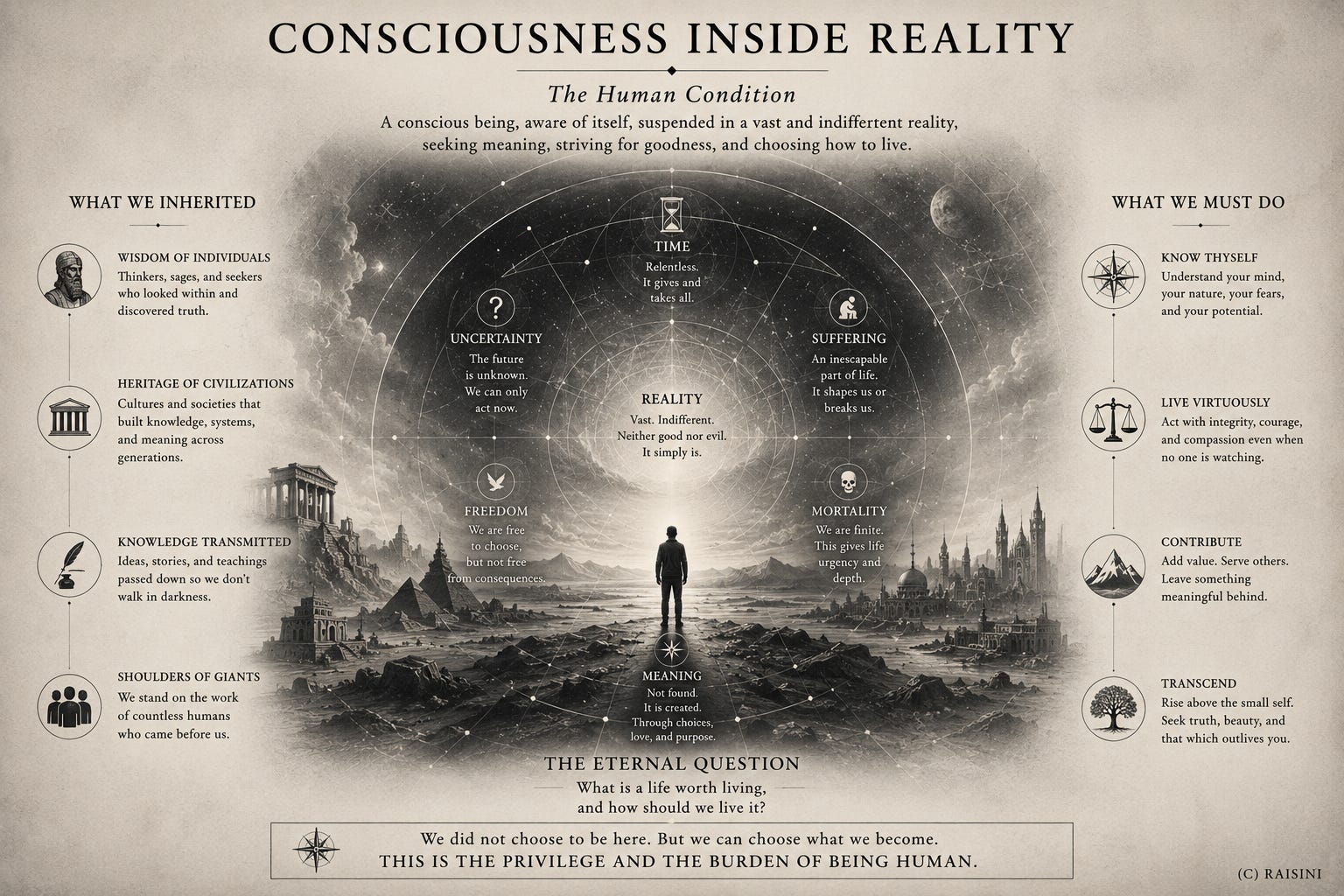
This is partly why the search for meaning appears across nearly every civilization regardless of geography, religion, political structure, or historical period. The language changes, but the underlying pattern remains remarkably consistent across time. Stoic thinkers such as Marcus Aurelius and Epictetus spoke about virtue, responsibility, discipline, and duty under conditions humans could never fully control. Buddhist traditions focused on awareness, suffering, attachment, compassion, and liberation from unconscious craving. Aristotle spoke about excellence cultivated through repeated action aligned with character and contribution rather than pleasure alone. Viktor Frankl wrote about responsibility, suffering, and the human need for meaning even under catastrophic conditions. Confucian traditions emphasized moral order, family obligation, education, and social harmony because civilizations understood that psychologically disoriented populations eventually become socially unstable. Even modern psychology repeatedly arrives at similar conclusions through different language: human beings deteriorate psychologically when they feel disconnected, directionless, fragmented, isolated, unnecessary, or existentially untethered from meaningful structure.
The modern world often treats purpose as a luxury concern reserved for the emotionally curious after material success has already been achieved. But history repeatedly suggests the opposite. Meaning was always psychological infrastructure. It helped human beings tolerate hardship, organize sacrifice, survive instability, endure uncertainty, and remain emotionally functional during difficult periods of life. Without orientation, people drift very easily toward compulsive distraction, endless consumption, addiction, emotional numbness, comparison, or quiet despair because the human mind struggles when suffering appears random, fragmented, or directionless. Meaning does not eliminate hardship. It organizes hardship into something psychologically survivable.
At the same time, one of the biggest misconceptions modern culture promotes is the belief that purpose must look extraordinary in order to matter. Many people unconsciously assume meaning must involve large audiences, historical importance, wealth, influence, visibility, recognition, or exceptional achievement. But some of the most meaningful lives throughout history were structurally quiet ones. Parents raising children with integrity. Teachers shaping minds without applause. Craftsmen dedicating decades to mastery. Writers leaving behind ideas that outlived them. Monks preserving knowledge through collapsing civilizations. Doctors healing strangers they would never know personally. Farmers sustaining communities generation after generation. Human beings consistently overestimate visibility while underestimating depth because modern systems increasingly condition people to associate attention with significance.
Social media intensified this distortion dramatically because modern environments reward visibility more aggressively than almost any civilization before them. People are constantly exposed to public performances of success, identity, wealth, status, influence, and achievement until significance itself begins feeling inseparable from public recognition. But reality functions differently from attention economies. Much of what actually stabilizes civilizations remains largely invisible. Responsibility is often invisible. Integrity is invisible. Loyalty is invisible. Discipline is invisible. Quiet competence is invisible. Yet these invisible forms of behavior are precisely what hold societies together across generations. The loudest lives are not necessarily the most meaningful ones. Sometimes they are simply the most visible.
Across thousands of years, civilizations repeatedly converged upon similar truths because human nature itself has not fundamentally changed despite technological advancement. Awareness matters because unconscious living creates drift. Responsibility matters because meaning deepens once human beings begin carrying something beyond immediate self-interest. Contribution matters because usefulness stabilizes identity psychologically. Alignment matters because external success without internal coherence eventually creates emptiness beneath the surface. Different cultures used different philosophies, symbols, religions, moral systems, and rituals, but many were attempting to solve the same underlying problem: how to help human beings live consciously inside an uncertain world without psychologically collapsing beneath the weight of existence itself.
Perhaps this is why purpose cannot be fully handed from one person to another like instructions inside a manual. Every human being eventually confronts the same difficult task of deciding what responsibilities they are willing to carry, what forms of suffering feel meaningful enough to endure, what values they refuse to betray, and what kind of life feels internally aligned rather than socially inherited. That process never fully ends because human beings continue evolving through experience, failure, responsibility, grief, aging, relationships, uncertainty, and time itself. A person at twenty is not confronting the same existential problem as a person at sixty. Purpose changes as identity changes because meaning is not static. It evolves through continuous interaction between the self and reality across different stages of life.
In the end, purpose is probably less mystical than many people imagine. It is not necessarily a hidden destiny waiting somewhere outside the self to be discovered fully formed. More often, meaning is constructed gradually through conscious participation in reality itself. Through responsibility carried consistently. Through contribution extended beyond personal gratification. Through awareness developed carefully enough to avoid unconscious drift. Through repeated alignment between values and behavior sustained across years rather than temporary emotional intensity.
A meaningful life is usually quieter than people expect. It is rarely built through permanent excitement, endless certainty, or continuous emotional fulfillment. More often, it is built through small consistent forms of integrity repeated long enough for a human being to stop living entirely by accident.
— Raisini
If you enjoyed this essay, please show your support by donating and help spread this story with a friend to help them find their purpose.
See you next week,
RAISINI
👉🏻 Connect on LinkedIn - LEONIDAS RAISINI
👉🏻 Listen to my music - RAISINI
👉🏻 Work with me - www.LeonidasRaisini.com
Founding Member
You can also become a founding member, where you will get a 15 Minutes consultation call with me, have access to super exclusive stories including access to my new Music before others, meet in person (if we are in the same city), invite to our events. All for $150 per year. [This is also a great option if you happen to have, say, an employer-sponsored reading or education budget.]
Copyright RAISINI 2026. Any illegal reproduction of this content will result in immediate legal action.
Thank you for your masterful elucidation.
Native Americans and Alaska Natives in the US are (at last) receiving resources from a variety of federal agencies to “revitalize” language and concomitantly culture—and practice some measure of self-determination.
The colonial educational system has been detrimental and counter productive since the beginning and indigenous populations are blamed for “failure” within that system.
What works for “increasing” Native American/Alaska Native student achievement in the US is the grounding of education in heritage language and culture. When education is relevant and a way to be part of and serving community it matters.
White America education is a tool to subtract knowledge about being a human being from children. As you point out the online reality and the focus on visibility further dissociates meaning.
The NA/AN solution is to foster, arrange and support the intergenerational Elder Youth connection.
love this one, as others. The slides are especially helpful and so aligned with my thinking.
Clare...aka Regina