

The Last Human Generation
Why The Next Century (2100 - 2200) May Change Humanity Forever

Welcome to this week’s issue of RAISINI.
Every week, i write about building a life on your own terms - through music, entrepreneurship, investing, health and brand-building. This isn’t theory. It’s what I’ve lived. Let’s keep going.
If you want access to private chats, live events, workshops, and more, consider becoming a paid or founding member.
For all of recorded history, civilizations changed while human beings remained remarkably similar. Empires rose and fell, technologies advanced, religions emerged, and societies reorganized themselves around new ideas, yet every generation inherited the same fundamental constraints: finite lifespan, inherited biology, limited cognition, imperfect memory, and mortality itself.
This essay explores a possibility that would have seemed impossible throughout most of human history: what happens when humanity acquires the ability to alter the very limitations that shaped every civilization before it?
Chapters
The Most Important Assumption In Human History
Civilization Changed. Humans Did Not.
The Human Condition As Infrastructure
Every Previous Revolution Changed The Environment
Why This Time May Be Different
The End Of Cognitive Scarcity
The End Of Biological Inheritance
The Death Of The Human Timeline
Humanity Becomes A Design Problem
The New Gatekeepers
The Dangerous Acceleration Problem
The First Self-Directed Species
What Happens To Civilization When Humans Change?
The New Inequality
The Reinvention Of Human Identity
The Last Human Generation
The Prophecy Instinct
A New Chapter In The Human Story
For all of history, every civilization inherited the same human being and, with it, the same human operating system. Different societies developed different religions, technologies, economies, and institutions, but all were built upon the same biological architecture. Humans aged. They forgot. They learned slowly. They feared death. They competed for status. They navigated the world through the same cognitive and emotional constraints inherited by every generation before them.
Empires rose and fell. Religions emerged. Markets expanded. Technologies transformed daily life. Yet beneath those changes stood the same biological creature. A Roman senator, a medieval farmer, a Chinese emperor, and a modern billionaire lived in radically different worlds, but they shared the same fundamental constraints. They aged. They forgot. They became ill. They feared death. They relied on limited intelligence, limited memory, limited attention, and finite time.
This stability is easy to overlook because it has always been present. History is usually told as a story of changing institutions, changing technologies, and changing societies. Much less attention is paid to the fact that the underlying human organism remained remarkably similar throughout those transformations. Civilization evolved rapidly. Human biology did not.
The next century may challenge that assumption. Artificial intelligence, genetic engineering, longevity science, synthetic biology, robotics, and brain-computer interfaces are not simply changing the environment around human beings. Increasingly, they are directed toward the human being itself. For the first time in history, technologies are emerging that may alter cognition, lifespan, biology, and capabilities that previous civilizations largely treated as fixed conditions of existence.
This essay is not an attempt to predict the future. It is not an argument that humanity is approaching utopia or catastrophe. The more interesting question is structural rather than speculative. What happens when the biological assumptions upon which civilization was built begin to change? What happens when intelligence becomes less scarce, biology becomes more editable, and longevity becomes more controllable? What happens when the stable human foundation beneath history becomes a variable?
For thousands of years, every generation inherited humanity. The possibility explored throughout this essay is that future generations may increasingly inherit modified versions of it.
The Most Important Assumption In Human History
History is often presented as a story of change. We divide the past into eras, civilizations, revolutions, and technological breakthroughs. We speak about the rise and fall of empires, the spread of religions, the emergence of markets, and the inventions that transformed daily life. The Roman Empire gave way to medieval Europe. Medieval Europe gave way to the Industrial Revolution. The industrial world gave way to the digital age. Each period appeared radically different from the one that came before it, creating the impression that human history is primarily a story of continual transformation.
A Roman senator would struggle to comprehend the world of a medieval king. A medieval king would find the factories of nineteenth-century Britain almost unimaginable. An industrial capitalist would likely view the internet, artificial intelligence, and global communication networks as something closer to science fiction than reality. The institutions, technologies, beliefs, and social structures that defined each era differed enormously. The distance between ancient Rome and modern civilization appears so vast that it is easy to focus exclusively on what changed.
Yet beneath those differences existed a remarkable continuity. The Roman senator, the medieval king, the industrialist, and the modern entrepreneur all belonged to fundamentally the same biological species. They lived under different political systems and used different tools, but they carried the same vulnerabilities. They aged. They became ill. They forgot things. They struggled with uncertainty. They feared loss and death. Their bodies remained fragile, their attention remained limited, and their intelligence existed within the same biological constraints that had shaped humanity for thousands of years.
This stability is so familiar that it often disappears from view. Human beings tend to notice movement rather than constants. We notice new technologies, new ideas, and new institutions because they stand out against the background of everyday life. The underlying human organism receives far less attention because it appears permanent. Yet that permanence may be one of the most important facts in all of history. Every civilization that has ever existed was built upon roughly the same human foundation. Governments assumed that people would live for a limited number of years. Economies assumed that intelligence and labor would remain scarce. Families assumed that generations would replace one another. Education assumed that knowledge had to be learned slowly and repeatedly. The basic architecture of civilization emerged around a relatively stable understanding of what a human being was.
This hidden stability helps explain why many institutions persisted across vastly different periods of history. Although civilizations changed dramatically, they were all responding to the same fundamental realities. Human beings remained mortal. Human memory remained imperfect. Human cognition remained limited. Disease remained a constant threat. Physical labor remained necessary. The circumstances surrounding life evolved, but the organism living that life changed very little. History therefore became a process of adapting civilization to the human condition rather than altering the human condition itself.
Most historical narratives focus on how societies transformed over time. Far less attention is given to the possibility that the human being itself might eventually become subject to the same process of transformation. For thousands of years, humanity changed its environment while remaining largely unchanged. We built cities, roads, markets, governments, religions, factories, and digital networks. We reshaped the world around us without fundamentally reshaping ourselves. The assumption that the human organism would remain relatively constant became one of the deepest and least examined assumptions beneath civilization.
The possibility explored throughout this essay is that this assumption may no longer hold. If previous eras were defined by humanity’s ability to transform its surroundings, the next era may be defined by humanity’s growing ability to transform itself. Before examining that possibility, it is necessary to understand the role that human stability played throughout history. Only then can we understand why the coming century may represent a break from a pattern that has existed since the beginning of civilization.
Civilization Changed. Humans Did Not.
When we look across the sweep of history, the scale of human achievement can appear almost limitless. Small groups of hunter-gatherers eventually became agricultural societies. Agricultural societies became cities. Cities became kingdoms, empires, nation-states, and global economies. Humanity learned to cultivate crops, construct monuments, navigate oceans, harness electricity, split the atom, and build digital networks capable of connecting billions of people in real time. The distance between a stone tool and a smartphone is so immense that it can create the impression that humanity itself has fundamentally transformed alongside its inventions.
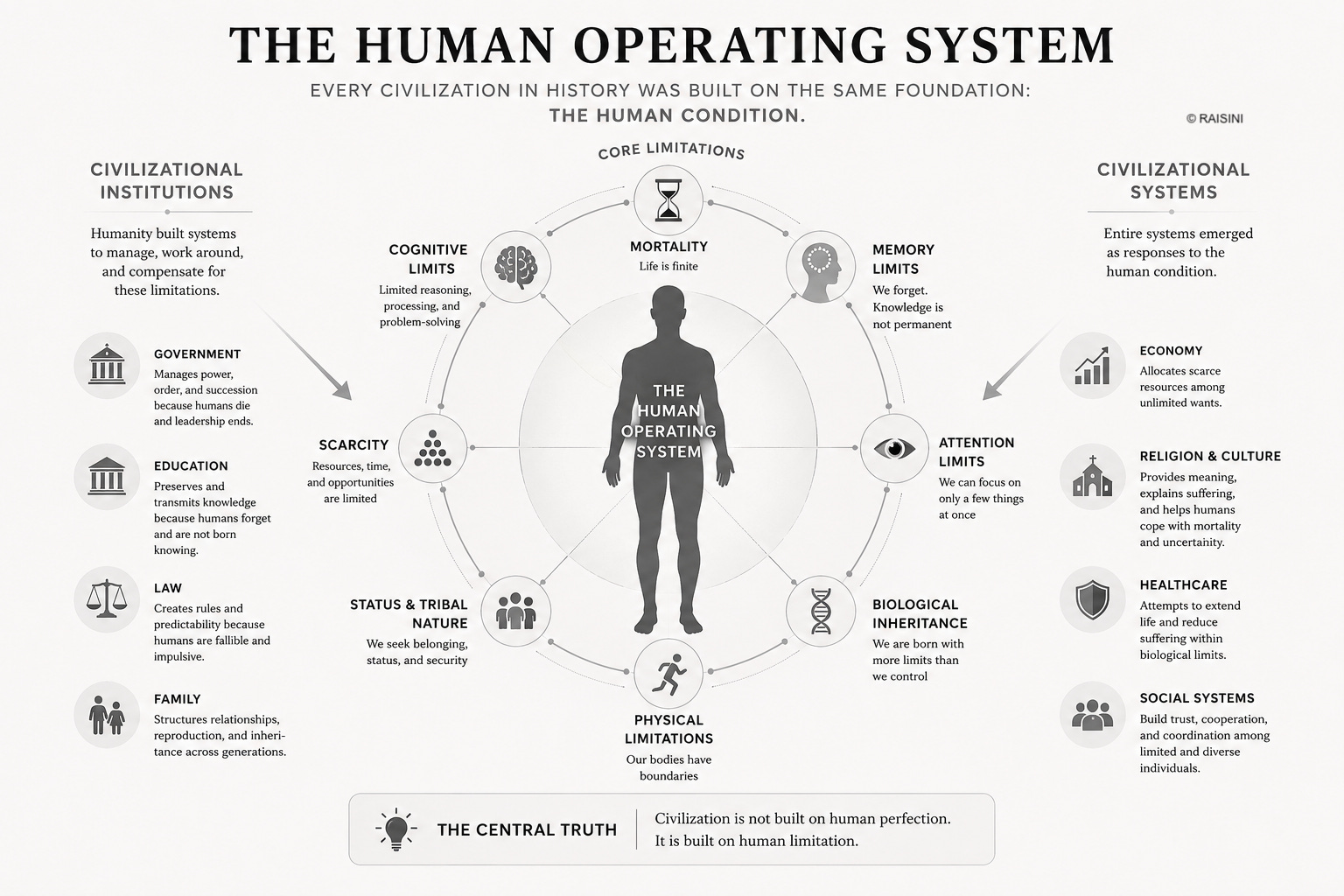
Yet this impression can be misleading. The civilizations surrounding human beings changed dramatically, but the human organism at the center of those civilizations remained remarkably stable. The farmers who first cultivated wheat in Mesopotamia lived within biological constraints that would still be recognizable today. Their descendants built cities, developed writing, created religions, established legal systems, invented money, and eventually constructed industrial economies, but the underlying human remained largely the same. The environment evolved rapidly. The organism evolved slowly.
One of the clearest examples of this stability is mortality. Every civilization in history has been shaped by the reality that human beings die. Ancient kingdoms, medieval societies, industrial economies, and modern governments all emerged within the same fundamental condition: every generation eventually disappears. Leaders die. Workers die. Parents die. Knowledge holders die. No matter how advanced a civilization became, it could not escape the fact that human life was temporary. Entire systems of inheritance, education, family structure, religion, and governance developed around this reality. Mortality was not simply a personal experience. It became a structural feature of civilization itself.
Human cognition remained equally stable. The modern world often creates the impression that people have become vastly more intelligent than their ancestors. In reality, most of the difference lies in accumulated knowledge rather than biological capability. A child born in ancient Athens and a child born in the twenty-first century possess remarkably similar cognitive hardware. What changed was the amount of information available to them, the institutions that transmitted knowledge, and the technologies that stored it. Civilization accumulated intelligence across generations, but the human brain itself remained largely unchanged. We became surrounded by more knowledge without fundamentally redesigning the organ responsible for understanding it.
The same pattern appears in emotion. The emotions described in ancient literature remain instantly recognizable today. Love, jealousy, ambition, grief, pride, envy, loyalty, fear, and hope appear throughout the oldest surviving records of human civilization. Political systems evolved. Religions evolved. Economies evolved. Human emotional architecture did not. The concerns of a Roman citizen, a medieval merchant, and a modern professional often differ in detail, yet the emotional mechanisms driving their decisions remain strikingly familiar. New circumstances emerged, but the emotional machinery interpreting those circumstances remained largely the same.
Status operates in a similar way. Every known civilization developed systems for ranking individuals and distributing prestige. The symbols changed. Ancient societies measured status through land, military achievement, noble lineage, or religious authority. Modern societies may emphasize wealth, education, influence, professional success, or public visibility. Yet beneath these differences lies a consistent pattern. Human beings continue to care deeply about relative position within social hierarchies. Technologies changed. Institutions changed. The status-seeking organism remained.
Attention and memory also reveal the persistence of human limitation. Modern technologies allow access to more information than any previous generation could have imagined, yet human attention remains finite. Every civilization confronted the problem of deciding what deserved focus and what could be ignored. Likewise, memory remained imperfect throughout history. Writing, books, libraries, databases, and cloud storage dramatically expanded civilization’s ability to preserve information, but these innovations compensated for human limitations rather than removing them. Civilization increasingly stored memory externally because individual human memory remained constrained.
Even physical limitation persisted despite extraordinary technological progress. Humans became capable of moving mountains, crossing oceans, and reaching space, yet they achieved these feats primarily through tools, machines, and systems rather than biological transformation. The average human body remained vulnerable to injury, disease, fatigue, and aging. Civilization continuously developed methods for extending human capability without fundamentally altering the organism being extended.
This distinction between civilizational change and biological stability is one of the least discussed patterns in history. Agriculture changed how humans acquired food. Cities changed how humans organized themselves. Religion changed how humans interpreted existence. Money changed how humans exchanged value. Industry changed how humans produced goods. The internet changed how humans communicated. Yet throughout these transformations, the same biological creature remained at the center of the system. Human beings continued to operate within inherited constraints shaped over thousands of years.
This stability became so normal that most institutions quietly assumed it would continue indefinitely. Civilizations changed because humans changed the world around them. The possibility that humanity might eventually begin changing the organism itself remained largely outside the historical experience of every previous society. Understanding this distinction is essential because it reveals the hidden constant beneath history. Civilization evolved rapidly while human biology remained comparatively stable. The possibility that this relationship may be changing is what makes the coming century historically unusual.
The Human Condition As Infrastructure
Most people think about human limitations as personal realities. Aging is something that happens to individuals. Forgetfulness is a personal weakness. Mortality is an individual fate. Scarcity is a challenge faced by households, businesses, or communities. Viewed from this perspective, the human condition appears primarily as a collection of private experiences that each person must navigate throughout life. What is less obvious is that these limitations do not merely shape individual lives. They shape entire civilizations.
Every society in history has been constructed around assumptions about what human beings can and cannot do. These assumptions became so deeply embedded within institutions that they often disappeared from view. Governments, economies, legal systems, educational structures, religions, and family arrangements evolved in response to recurring features of human nature. They were not built around idealized humans. They were built around limited humans. In many ways, civilization itself can be understood as a collection of solutions to biological constraints.
What appears at first to be a collection of unrelated limitations is better understood as a single system. Human beings age. They forget. They possess limited attention, limited cognition, limited time, and limited physical capability. These constraints interact with one another and shape how societies organize themselves. Every civilization inherited essentially the same human operating system, and many of its institutions emerged as adaptations to that operating system rather than as purely abstract inventions.
Consider government. Political systems assume that human beings die. This may sound obvious, but its implications are profound. Every mechanism of succession, inheritance, election, appointment, and transfer of power exists because no leader remains indefinitely. Kingdoms developed rules for succession. Republics developed systems for replacing officials. Modern states created bureaucracies capable of surviving beyond the individuals who govern them. The continuity of political authority depends upon the expectation that every generation will eventually disappear. Mortality is not simply a biological fact. It is a foundational assumption built into the architecture of governance.
Education operates according to a similar logic. Every educational institution begins with the assumption that knowledge is not automatically inherited. Human beings are not born knowing mathematics, engineering, medicine, law, history, or language. Knowledge must be transmitted repeatedly from one generation to the next because memory exists within individuals rather than within the species itself. Schools, universities, apprenticeships, libraries, and training systems emerged to compensate for this reality. Civilization preserves knowledge externally because human beings forget. If perfect memory were a natural human trait, many educational structures would look fundamentally different.
Economic systems are likewise shaped by limitation. Scarcity is one of the most important assumptions in economics because human wants consistently exceed available resources. Time is limited. Attention is limited. Labor is limited. Expertise is limited. Capital is limited. Markets emerged as mechanisms for allocating scarce resources among competing demands. Entire economic theories rest upon the observation that human beings operate within constraints. Prosperity, productivity, and growth all depend on how effectively societies manage limitations that cannot simply be wished away.
Families represent another example of infrastructure built around biology. Every civilization assumes that generations replace one another. Parents raise children. Children become adults. Adults eventually become parents themselves. Inheritance, kinship, property ownership, social obligations, and cultural continuity all depend upon this cycle. Family structures differ across cultures, but the underlying reality remains remarkably consistent. Human societies organize themselves around reproduction because every generation must be replaced by another. The family is not simply a social arrangement. It is an institutional response to mortality and succession.
Religion may be the clearest example of civilization adapting to the human condition. Across cultures and centuries, religious traditions repeatedly confronted the same questions.
Why do people suffer?
Why do people die?
How should people live?
What happens after death?
How should individuals find meaning within a finite existence?
The specific answers varied, but the underlying concerns remained remarkably stable. Religion emerged not only as a set of beliefs but as a framework for helping human beings navigate realities that no civilization has ever escaped. Mortality, uncertainty, fear, grief, and meaning-seeking became central religious concerns because they are central human concerns.
What makes these examples significant is that they reveal a deeper pattern. Human limitations are not isolated features of individual life. They function as the invisible infrastructure beneath civilization itself. Institutions do not merely manage society. They manage recurring aspects of the human condition. Governments manage succession. Education manages forgetting. Economies manage scarcity. Families manage generational replacement. Religions manage mortality and meaning. The structures of civilization evolved around constraints that appeared permanent.
This perspective changes how history is interpreted. Instead of viewing institutions as independent creations, they can be understood as adaptations to a stable biological reality. Civilizations differed in countless ways, yet they repeatedly developed solutions to similar human problems because the underlying organism remained largely unchanged. The human condition provided the foundation. Institutions emerged in response.
This idea becomes increasingly important once we begin considering the possibility that some of these limitations may become less fixed than they once appeared. If civilization was built around mortality, scarcity, forgetting, biological inheritance, finite cognition, and generational succession, then any meaningful change to those conditions would have consequences extending far beyond individual lives. It would affect the infrastructure of civilization itself.
Throughout history, the human operating system remained sufficiently stable that institutions could evolve around it. Governments assumed mortality. Education assumed forgetting. Economies assumed scarcity. Families assumed succession. Religions assumed suffering and death. These assumptions became embedded within civilization so deeply that they came to appear permanent. The institutions surrounding us were not built in spite of human constraints. They were built because of them. The question explored throughout the remainder of this essay is what happens when some of those constraints cease to be as fixed as they once were.
Every Previous Revolution Changed The Environment
Human history is often described through its revolutions. Agriculture transformed survival. Writing transformed memory. The printing press transformed knowledge. Industry transformed production. Electricity transformed daily life. Computers transformed information. The internet transformed communication. Each innovation altered how people lived, worked, organized themselves, and understood the world. These developments were so consequential that entire eras of history are often defined by the technologies they introduced.
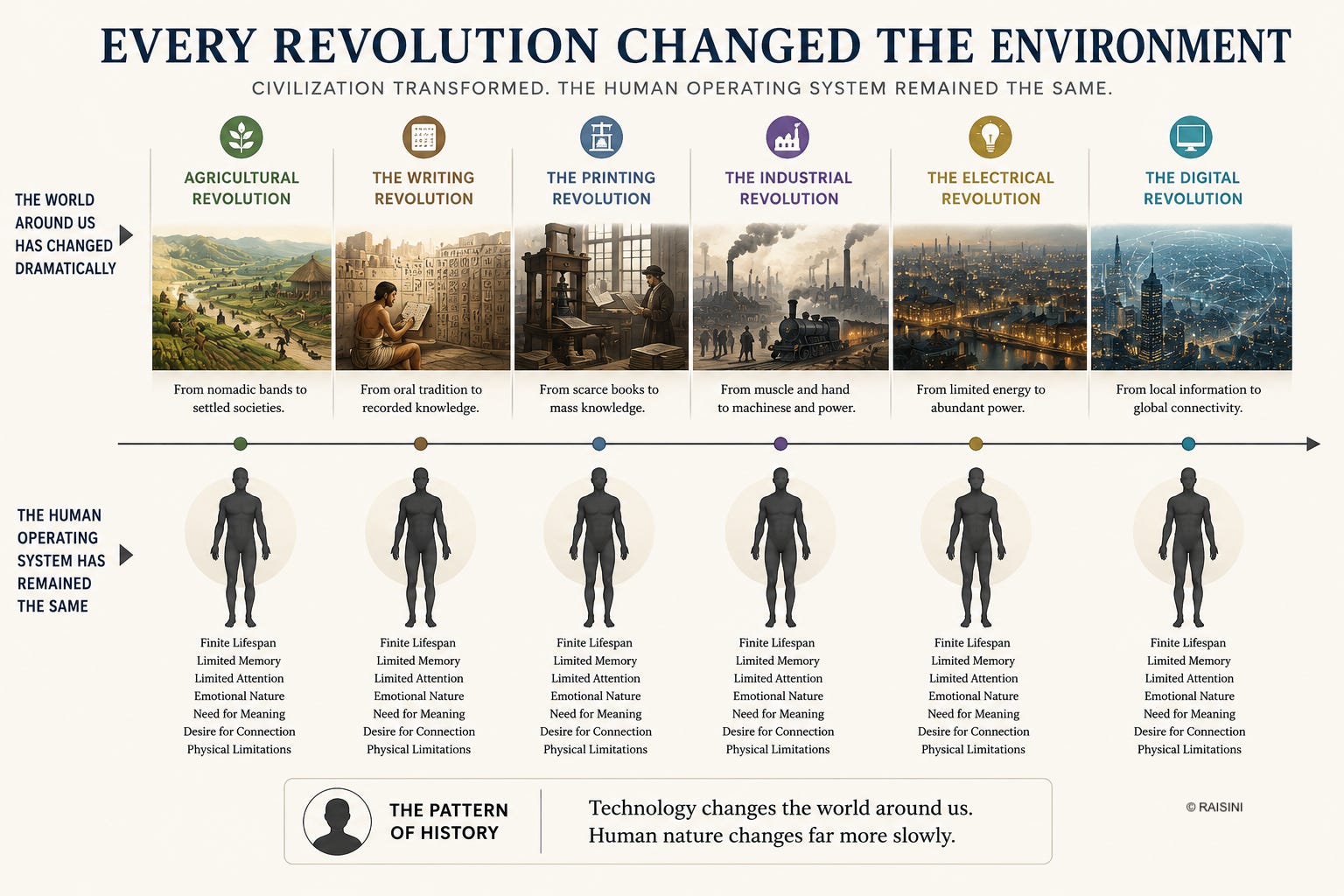
Despite their enormous impact, these revolutions shared an important characteristic. They changed the environment surrounding human beings far more than they changed human beings themselves. They expanded human capability without fundamentally redesigning the organism using those capabilities. The tools became more powerful. The systems became more complex. The world became more interconnected. Yet the biological human at the center of these transformations remained remarkably familiar.
Agriculture provides one of the earliest examples. Before farming, human beings lived primarily as hunter-gatherers. Agriculture altered settlement patterns, population growth, social organization, and food production. It enabled cities, governments, trade networks, and eventually civilization itself. Yet agriculture did not fundamentally change what a human being was. Farmers still relied upon the same cognitive abilities, emotional responses, physical bodies, and biological limitations that had existed before cultivation began. The environment became more stable and productive, but the organism remained largely unchanged.
Writing represented another revolutionary breakthrough. For the first time, information could survive beyond the memory of individuals. Knowledge no longer disappeared when its holder died. Laws could be recorded. Histories could be preserved. Complex administrations became possible. Writing dramatically expanded the capacity of civilization to store and transmit information across generations. Yet writing did not eliminate the limitations of human memory. It compensated for them. Civilization created an external memory system precisely because human memory remained imperfect.
The printing press accelerated this process on an unprecedented scale. Knowledge that once required laborious copying could suddenly be reproduced and distributed widely. Literacy expanded. Scientific ideas spread more rapidly. Religious and political authority became more difficult to monopolize. Entire intellectual movements emerged because information could travel more efficiently than before. Yet the printing press did not alter the biological mechanisms through which human beings learned, understood, or remembered. It transformed access to knowledge while leaving the underlying cognitive architecture intact.
The Industrial Revolution produced an even more dramatic transformation. Machines amplified human productivity beyond anything previous generations could have imagined. Goods that once required immense labor could be produced at scale. Transportation accelerated. Urbanization intensified. Entire economic systems were reorganized around mechanized production. Yet industry did not remove physical human limitations. It worked around them. Engines replaced muscle. Factories multiplied output. Machines compensated for biological constraints rather than eliminating them.
Electricity extended this pattern further. Human activity was no longer tied so closely to daylight. Communication accelerated. Cities expanded. Homes, workplaces, and infrastructure became increasingly dependent upon continuous energy. Electricity reshaped the rhythm of civilization itself. Yet the human organism continued to require sleep, rest, recovery, and biological maintenance. Electricity transformed the conditions under which people lived without fundamentally transforming the people themselves.
Computers and digital technologies created another leap in capability. Calculations that once required teams of specialists could be completed in moments. Information could be stored, copied, and processed at extraordinary speed. Entire industries emerged around digital systems. Yet computers did not alter the biological limits of human cognition. They supplemented those limits. Humans remained constrained by attention, memory, and processing capacity. Computers became valuable precisely because those constraints continued to exist.
The internet extended this logic globally. Information became accessible across continents in seconds. Communication barriers collapsed. Markets, institutions, and communities became increasingly interconnected. Humanity gained access to more information than any previous generation could have imagined. Yet even within this environment of abundance, human attention remained scarce. The internet dramatically increased the volume of information available to individuals, but it did not expand the amount of attention individuals could devote to that information. The limitation persisted while the environment surrounding it transformed.
Viewed together, these revolutions reveal a recurring pattern. Human beings repeatedly changed the world around them in order to overcome biological constraints. Agriculture addressed food scarcity. Writing addressed imperfect memory. Printing addressed limited access to knowledge. Industry addressed physical weakness. Electricity addressed environmental constraints. Computers addressed computational limitations. The internet addressed communication barriers. Each innovation expanded what humans could accomplish without fundamentally changing what humans were.
This distinction matters because it highlights an overlooked feature of history. The most transformative technologies were generally directed outward. They reshaped environments, institutions, and systems. They altered the conditions under which humans operated while leaving the underlying organism relatively stable. Civilization became more powerful because humans learned how to compensate for limitations, not because those limitations disappeared.
The possibility emerging in the twenty-first century is different. Increasingly, new technologies are not only directed toward the environment surrounding humanity. They are directed toward humanity itself. Understanding this shift requires recognizing how unusual it would be compared with every major revolution that came before it. Most revolutions changed the world around human beings. The possibility now being explored is whether future revolutions may begin changing the human being as well.
Why This Time May Be Different
Every generation believes it is living through unprecedented change. The people who witnessed the arrival of railways, electricity, automobiles, radio, television, aviation, nuclear power, and the internet all experienced technologies that appeared capable of reshaping civilization. In many cases, they were correct. These innovations transformed economies, institutions, communication, transportation, and daily life. History is filled with moments when technological change seemed to divide one era from another.
This is why claims about the uniqueness of the present should be approached carefully. Most predictions about revolutionary change are exaggerated. Human beings are naturally drawn toward narratives that place their own generation at the center of history. The challenge is distinguishing ordinary technological progress from genuinely unusual shifts in the relationship between civilization and the human organism itself.
What makes several emerging technologies different is not simply their power. Powerful technologies are nothing new. What makes them unusual is the object toward which that power is increasingly directed. For most of history, innovation focused on changing the environment around human beings. The technologies now attracting the greatest attention increasingly focus on changing human beings themselves.
Artificial intelligence illustrates this shift. The significance of AI is often framed in terms of productivity, automation, economic disruption, or employment. Those issues matter, but they may not be the deepest implication. Intelligence has historically been one of the most valuable and limited resources within civilization. Every institution, profession, government, and economy depends upon human cognitive capacity. As AI systems become more capable, they increasingly interact with one of the defining characteristics of the human organism itself: the ability to think, reason, create, learn, and solve problems. Whether AI ultimately supplements human intelligence or competes with it, the target is no longer merely the external environment. The target is cognition.
Genetics introduces a similar shift at the biological level. For almost all of history, human beings inherited their biological characteristics in the same way every previous generation had inherited theirs. Biology was largely accepted as a starting condition rather than a design choice. Advances in gene editing, genetic screening, and molecular biology raise the possibility that inherited traits may become increasingly subject to intervention. The significance is not any single technology. The significance is that biology itself becomes a domain in which intentional modification may occur.
Longevity research pushes against another assumption that has shaped civilization since its beginning. Every institution operates within the expectation that human beings age and eventually die. Aging has always been treated as a biological reality rather than an engineering challenge. Modern research increasingly treats it as both. Whether meaningful lifespan extension arrives quickly, slowly, or not at all, the important shift is conceptual. Aging is no longer viewed exclusively as an unavoidable condition. It is increasingly viewed as something that can be studied, influenced, delayed, or modified.
Synthetic biology expands this pattern further. Human beings have spent thousands of years manipulating the environment through agriculture, engineering, and chemistry. Synthetic biology extends intervention into the processes of life itself. The ability to design, modify, and influence biological systems introduces possibilities that previous civilizations could scarcely imagine. Once again, the importance lies less in specific applications than in the direction of innovation. The focus moves closer to the foundations of living systems.
Robotics appears different at first glance because it primarily concerns machines rather than biology. Yet its deeper significance emerges when viewed through the same framework. Human societies have always depended upon physical labor. Economic systems, social structures, and institutions evolved around the assumption that human effort was required to produce, transport, build, maintain, and operate the physical world. Increasingly capable robotics challenge that assumption. As machines become more autonomous, they begin interacting with one of humanity’s oldest limitations: physical capability itself.
Brain-computer interfaces may represent the clearest example of the broader shift. Previous technologies allowed humans to interact with tools externally. A book extends memory. A computer extends calculation. A smartphone extends communication. Brain-computer interfaces move the relationship closer to direct integration between biological cognition and technological systems. Whether such technologies remain limited or become widespread is uncertain. What matters is the trajectory. The boundary between human capability and technological capability becomes less clearly defined.
Viewed individually, each of these fields raises important questions. Viewed collectively, they reveal something more significant. They all point toward a gradual shift in the target of innovation. Intelligence, biology, aging, physical capability, and cognition have historically been treated as relatively fixed characteristics of the human organism. Increasingly, they are becoming areas in which intervention appears technologically conceivable.
This does not mean dramatic transformation is inevitable. Many emerging technologies fail to achieve their most ambitious goals. Progress often arrives more slowly than enthusiasts predict. Technical, economic, ethical, political, and social constraints remain substantial. The argument is not that humanity will necessarily redesign itself. The argument is that humanity has begun developing tools capable of attempting to do so.
That possibility distinguishes the present from many previous technological revolutions. Agriculture, industry, electricity, and the internet changed the world around human beings. The technologies now emerging increasingly point inward. For the first time in history, the most consequential innovations may be directed not toward the environment, but toward the organism that created the environment in the first place.
The next revolution may therefore be remembered differently from those that came before it. Its defining characteristic may not be a new machine, a new energy source, or a new communication network. It may be the moment when the toolmaker itself became the subject of innovation.
The End Of Cognitive Scarcity
One of the foundational assumptions embedded within civilization’s infrastructure is the scarcity of intelligence. Every society in history has operated under the reality that expertise is limited, knowledge is unevenly distributed, and highly capable thinkers are rare. Educational systems, governments, corporations, scientific institutions, and entire economies developed around this constraint. The significance of artificial intelligence is not merely that it performs useful tasks. Its deeper significance is that it may challenge one of the oldest assumptions upon which civilization has been organized: that intelligence is scarce.
Because intelligence was scarce, civilizations developed mechanisms for concentrating it. Universities, professional guilds, scientific institutions, bureaucracies, research laboratories, and educational systems all emerged partly as solutions to the same problem: capable minds were valuable, but they were limited in number. Knowledge accumulated slowly because expertise was difficult to acquire and even more difficult to distribute. Scientific progress often depended upon small groups of specialists. Economic growth relied upon the availability of skilled professionals, engineers, physicians, inventors, administrators, and researchers. The history of civilization is, in part, the history of societies attempting to organize scarce intelligence more effectively.
The importance of this scarcity is often overlooked because it has always existed. Human beings are accustomed to living in a world where expertise is difficult to acquire, expensive to access, and unevenly distributed. Becoming highly skilled in any complex domain typically requires years of education, training, experience, and practice. The most capable experts remain relatively rare, which gives their knowledge significant value. Much of civilization operates on the assumption that advanced cognitive capability is both important and limited.
This assumption influences everything from education and healthcare to law, engineering, science, finance, and government. A society can only train so many surgeons. It can only produce so many skilled scientists. It can only rely on a finite number of highly capable decision-makers. Expertise becomes a bottleneck through which progress must pass. The pace at which civilization advances is often constrained by the number of people capable of solving increasingly complex problems.
Artificial intelligence introduces the possibility that this constraint may begin to weaken. The significance of AI is frequently framed through the lens of automation, productivity, or economic disruption. While those consequences may prove important, they are not necessarily the deepest implication. The more fundamental question concerns the nature of intelligence itself as a civilizational resource.
For thousands of years, intelligence could not be scaled. A brilliant scientist remained one person. A gifted engineer could only work on a limited number of problems. A talented physician could only treat a finite number of patients. Knowledge could be taught and transmitted, but expertise remained tied to individual human minds. Civilization depended upon multiplying intelligence through education because intelligence itself could not be replicated.
AI introduces a different possibility. Once a capable system exists, it can potentially be deployed simultaneously across countless tasks, locations, and contexts. Unlike human expertise, it does not require decades of training for each additional instance. Whether current systems fully achieve this capability is less important than the direction of the trend. For the first time, civilization is exploring the possibility that certain forms of intelligence may become scalable.
The implications extend far beyond efficiency. Consider what happened when access to information expanded. For most of history, knowledge was concentrated within small groups of scholars, religious institutions, governments, and elites. The printing press dramatically increased access to information. The internet expanded it further. Knowledge became more abundant even though human intelligence remained scarce.
Artificial intelligence may represent a similar transition, but at a different level. The question is no longer only whether information becomes abundant. The question is whether increasingly sophisticated reasoning, analysis, explanation, and problem-solving become widely accessible as well. If that occurs, civilization may experience a shift comparable to previous information revolutions, but operating at the level of cognition itself.
This possibility raises questions that extend beyond economics. What happens when expertise becomes available on demand rather than concentrated within institutions? What happens when complex analysis can be accessed by individuals who previously lacked access to specialized knowledge? What happens when the ability to navigate legal systems, medical information, scientific research, technical problems, or educational challenges becomes less dependent on finding a scarce expert?
The question is not whether human intelligence becomes irrelevant. Human judgment, creativity, values, goals, and decision-making remain essential. The more important observation is that civilization has always been organized around the scarcity of advanced cognitive capability. Educational systems, professional hierarchies, credentialing structures, and institutions evolved within that reality. If the scarcity itself begins to change, the systems built around it may eventually change as well.
History offers few examples of resources moving from scarcity to abundance without producing profound consequences. When energy became more available, economies transformed. When information became more accessible, societies transformed. If intelligence becomes increasingly abundant, even in limited forms, the consequences may extend across every domain that relies upon human cognition.
None of this guarantees a particular future. Artificial intelligence may remain constrained in important ways. Human expertise may continue to occupy roles that machines cannot easily replicate. New limitations may emerge as old ones weaken. The outcome remains uncertain. What appears less uncertain is that civilization has begun confronting a possibility that previous generations never faced.
For all of history, intelligence was one of humanity’s most valuable scarce resources. The emerging question is what happens when that scarcity begins to erode. If previous civilizations were shaped by the limited availability of capable minds, future civilizations may be shaped by the increasing availability of intelligence itself.
The End Of Biological Inheritance
Another assumption embedded within civilization’s infrastructure is that biology is largely inherited rather than designed. Every generation received a genetic inheritance over which it exercised little control. Families, healthcare systems, insurance structures, and social expectations developed around this reality. The significance of genetics and biological engineering is not simply that they may prevent disease. Their deeper significance is that they may weaken one of civilization’s oldest assumptions: that human biology arrives largely through inheritance rather than intentional design.
For almost all of human history, biology was treated as fate. A person inherited a particular body, a particular genetic makeup, a particular collection of strengths, vulnerabilities, predispositions, and limitations. Some inherited resistance to disease. Others inherited susceptibility. Some inherited exceptional physical capabilities. Others inherited disadvantages they could do little to change. Regardless of wealth, status, intelligence, or power, every generation largely accepted biology as a starting condition rather than a design choice.
This assumption shaped civilization at every level. Medicine focused primarily on treating illness after it appeared. Families passed genetic traits to their children without knowing precisely what was being transmitted. Governments built healthcare systems around managing disease rather than preventing it before birth. Human beings understood inheritance as something received rather than something directed. Biology belonged to the realm of nature, not engineering.
The development of genetics began altering that perception. As scientists gradually uncovered the mechanisms through which traits are inherited, biology became more understandable. DNA transformed inheritance from a mystery into a system that could be studied, analyzed, and eventually influenced. The significance of this discovery extended far beyond medicine. It suggested that characteristics once considered fixed might not remain entirely beyond human intervention.
The first consequences appeared in disease prevention. Genetic screening made it possible to identify inherited conditions before symptoms emerged. Families gained access to information that previous generations could never possess. Certain diseases could be anticipated, monitored, or avoided altogether. The objective shifted from responding to biological outcomes toward influencing them earlier in the process. Biology remained inherited, but inheritance became increasingly visible.
Embryo selection introduced another step. In some cases, prospective parents gained the ability to select between embryos based on genetic characteristics. The technology remains limited and often controversial, but its significance extends beyond current capabilities. For the first time, decisions that once belonged entirely to chance became partially subject to human choice. The process did not create new biology. It altered how inherited biology was selected.
Gene editing moves further along the same trajectory. Instead of merely observing or selecting genetic outcomes, it introduces the possibility of directly modifying them. Much of the public discussion focuses on disease prevention, and understandably so. The ability to reduce the risk of severe inherited disorders represents a profound medical achievement. Yet the broader implication reaches beyond any individual application. The deeper shift occurs when biology itself becomes a domain in which intentional intervention is technically possible.
The importance of this transition is often misunderstood because discussions about genetics tend to focus on specific technologies. The larger question is not whether a particular technology succeeds or fails. The larger question is how civilization changes once biology becomes a domain of intervention rather than acceptance. History offers few examples of transitions this fundamental. Most technologies allowed humans to modify their environment. Genetics introduces the possibility of modifying the biological foundation from which every future generation emerges.
This possibility raises questions that extend far beyond medicine. If inherited traits can be influenced, selected, or modified, the distinction between biological chance and biological design becomes less clear. Concepts that have remained stable throughout history begin to shift. Human variation, health, capability, risk, and even the meaning of inheritance itself become subjects of active decision-making rather than passive acceptance.
The implications become even more significant when viewed over long time horizons. Most technological changes affect individuals during their lifetime. Genetics operates differently. Biological modifications can potentially extend across generations. A decision made today may influence individuals who have not yet been born. This introduces a level of temporal reach rarely encountered elsewhere in civilization.
None of this means that humanity will suddenly gain complete control over biology. Human genetics remains extraordinarily complex. Many traits emerge through interactions that are only partially understood. Technical limitations, ethical concerns, regulatory constraints, and scientific uncertainty remain substantial. The future is unlikely to resemble simplistic visions of engineered perfection. Biology is too intricate for such assumptions.
What matters is not the certainty of radical transformation. What matters is the direction of change. For thousands of years, every civilization inherited human beings largely as nature produced them. Future civilizations may inherit human beings whose biological characteristics were influenced, selected, modified, or engineered to varying degrees before birth. Even modest movement in that direction represents a historical departure from nearly everything that came before.
The significance therefore lies not in any single breakthrough, but in the changing relationship between humanity and its own biology. For most of history, inheritance was something received. Increasingly, it may become something managed. The human organism would no longer be viewed exclusively as a product of biology and chance. It would also become, at least partially, a product of design.
If previous civilizations were built upon inherited human nature, future civilizations may emerge under conditions where inheritance itself becomes increasingly subject to intervention. That possibility marks one of the most profound shifts explored in this essay. Human biology may cease to be something merely inherited and become something increasingly engineered.
The Death Of The Human Timeline
Perhaps no assumption is more deeply embedded within civilization’s infrastructure than mortality itself. Every institution assumes that human beings age, decline, and eventually disappear. Careers end. Wealth transfers. Political leaders leave office. Knowledge passes between generations. Entire social systems are organized around the expectation that one generation eventually gives way to the next. The significance of longevity research is not merely that it may extend life. Its deeper significance is that it may challenge one of the most fundamental assumptions upon which civilization was built: that generations eventually die.
Every civilization in history has been organized around a simple biological reality: human beings age and eventually die. This fact is so fundamental that it often disappears into the background of everyday life. Most people rarely think about how deeply mortality shapes the structures surrounding them. Yet death is not merely a personal event. It is one of the hidden organizing principles of civilization itself.
Generations function as the basic rhythm through which societies renew themselves. Children replace parents. New workers replace retirees. New leaders replace old ones. Wealth passes through inheritance. Knowledge transfers across generations. Political systems, educational institutions, labor markets, family structures, and cultural traditions all operate within the expectation that people enter society, participate for a period of time, and eventually leave it. Civilization is built upon a continuous cycle of succession.
This cycle influences far more than population statistics. Careers assume limited working lives. Educational systems assume that individuals must acquire knowledge quickly enough to apply it before old age. Pension systems assume retirement followed by death within a predictable timeframe. Political systems assume leadership turnover. Economic mobility often depends upon generational transitions. Even social influence gradually shifts as older generations disappear and younger generations assume positions of authority.
Mortality performs an often overlooked function within these systems. It creates space. New ideas emerge partly because older ideas eventually lose their institutional holders. New businesses emerge because existing leaders cannot occupy positions indefinitely. Wealth circulates because ownership eventually transfers. Political power changes hands because individuals cannot govern forever. The death of individuals contributes to the renewal of institutions.
This does not mean mortality is desirable. It means civilization has evolved around its existence. Those institutions were designed around a relatively predictable human lifespan, not around populations capable of remaining healthy and productive for dramatically longer periods. Most societies expect childhood, adulthood, middle age, retirement, and death to occur in roughly the same sequence and within roughly similar time horizons. These assumptions shape everything from financial planning to public policy.
Longevity research introduces the possibility that these assumptions may weaken. Discussions about lifespan extension often focus on the individual benefits of living longer. Healthier lives, reduced disease, and extended vitality are obvious advantages. Yet the larger significance may lie elsewhere. The deeper question is what happens when societies built around mortality encounter populations that remain healthy, productive, and active for substantially longer periods.
The issue is not immortality. Civilization does not need indefinite lifespan for the effects to become significant. Even modest extensions could create profound consequences. A world in which large numbers of people remain healthy and productive into their second century of life would differ substantially from the world that shaped every previous civilization. The biological timeline around which institutions were designed would begin to shift.
Consider expertise. Throughout history, knowledge has often disappeared with those who possessed it. Every generation spends considerable effort rebuilding, rediscovering, and retransmitting experience. If individuals remained active for dramatically longer periods, expertise could accumulate in unprecedented ways. Scientists, engineers, physicians, entrepreneurs, and leaders might possess decades more experience than their historical counterparts. The concentration of knowledge within individuals could reach levels civilization has rarely encountered.
Wealth accumulation presents a similar challenge. Modern economic systems already struggle with questions surrounding inequality and intergenerational transfer. If productive lifespan expands significantly, existing patterns of ownership, investment, and capital accumulation may become increasingly concentrated. Individuals would have far more time to build wealth, maintain influence, and expand control over resources. The economic assumptions built around generational turnover would begin to change.
Political systems could face similar pressures. Much of modern governance assumes a steady replacement of political actors over time. Elections, term limits, retirement, and succession all operate within the broader context of human mortality. If leaders remain healthy and capable for far longer than previous generations, the relationship between power and time could evolve in ways that existing institutions were never designed to manage.
Family structures would likely change as well. Human relationships have always existed within the context of limited lifespan. Parents, grandparents, and great-grandparents occupy relatively predictable positions within family life because generations remain separated by mortality. Longer lives could create family structures extending across far more overlapping generations, altering inheritance, caregiving, responsibility, and social identity in ways that are difficult to fully anticipate.
The most important observation is that mortality does not simply shape individual lives. It shapes institutional design. Civilization was constructed around predictable cycles of aging, succession, replacement, and death. Human death is not only a biological reality. It is a structural assumption embedded within institutions. Entire systems depend upon predictable cycles of replacement and renewal. Many institutions derive their stability from turnover itself. New participants enter because existing participants eventually leave.
Longevity technologies therefore raise questions that extend far beyond healthcare. They challenge one of the oldest organizing principles in human history. If people live substantially longer while remaining healthy and productive, civilization may need to reconsider assumptions that have remained largely unchanged for thousands of years.
This is why longevity matters within the broader argument of this essay. The significance is not simply that people might live longer. The significance is that mortality has quietly shaped the architecture of civilization from the beginning. If that constraint weakens, even partially, the institutions built around it may eventually weaken as well.
Modern civilization assumes that generations die. The deeper question is what happens when that assumption no longer carries the same certainty it once did.
Humanity Becomes A Design Problem
The previous chapters examined individual assumptions embedded within civilization’s infrastructure: the scarcity of intelligence, the inheritance of biology, and the inevitability of aging. Viewed separately, each appears significant. Viewed together, they reveal a larger pattern. The technologies emerging today are not simply producing new capabilities. They are beginning to challenge the assumptions around which civilization itself has been organized. Humanity is no longer merely designing tools that operate within existing limitations. Increasingly, it is developing tools capable of altering the limitations themselves.
For most of history, human beings designed tools to overcome limitations they could not remove. The spear compensated for physical weakness. Clothing compensated for environmental exposure. Writing compensated for imperfect memory. Mathematics compensated for cognitive limits. Machines compensated for insufficient muscle. Computers compensated for limited calculation. Every major technological achievement followed the same basic pattern. Human beings accepted their biological constraints and then built increasingly sophisticated systems around them.
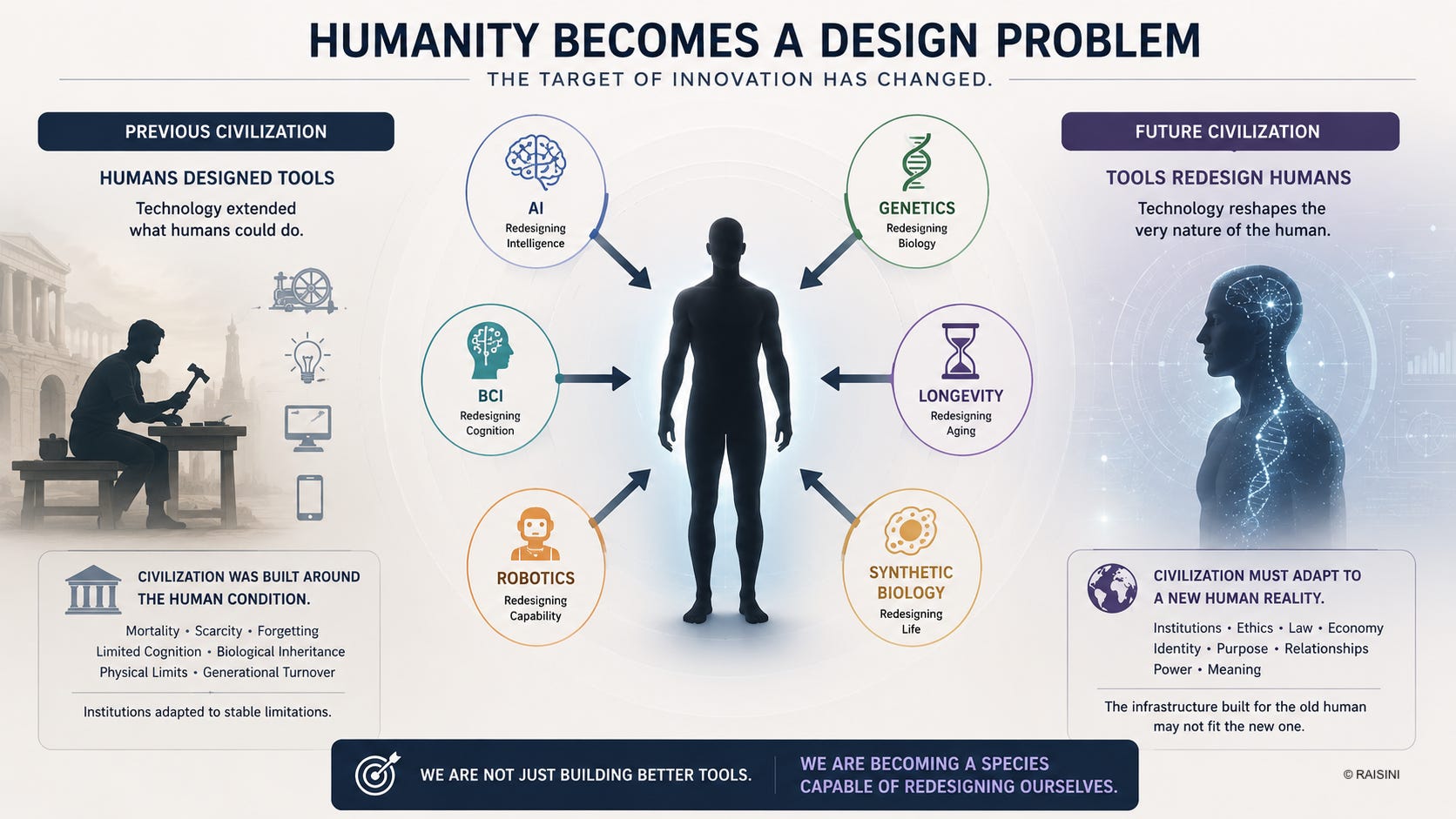
This pattern shaped the entire development of civilization. Progress was measured not by changing human nature, but by expanding what humans could accomplish despite human nature. The goal was never to eliminate limitation itself. The goal was to reduce its consequences. A civilization became more advanced by creating better tools, better institutions, and better environments within which ordinary human beings could operate.
The technologies discussed throughout this essay suggest a different trajectory. Artificial intelligence, genetics, longevity research, synthetic biology, robotics, and brain-computer interfaces may appear to belong to separate fields. They are often discussed independently because they involve different scientific disciplines, industries, and applications. Yet viewed from a wider perspective, they reveal a common direction.
This shift represents something more significant than technological progress. It alters the relationship between humans and the problems technology attempts to solve. For most of history, technological progress expanded what humans could accomplish without fundamentally altering the humans themselves. Intelligence was limited, so societies created schools, libraries, universities, and computers. Physical strength was limited, so societies created machines and infrastructure. Lifespans were limited, so societies organized themselves around generations. The constraint remained stable while the solutions evolved.
Now the constraint itself is increasingly becoming the subject of intervention. Artificial intelligence raises questions about whether cognitive limitations should continue to define the boundaries of human capability. Genetics raises questions about whether inherited biology should remain untouched. Longevity research raises questions about whether aging should continue to function as an unavoidable condition of life. Brain-computer interfaces raise questions about whether memory, learning, and cognition must remain confined within the traditional limits of the human brain.
The importance of these developments is often misunderstood because public discussion tends to focus on individual technologies. Debates emerge around specific products, scientific breakthroughs, companies, or research programs. Yet the larger pattern can easily disappear beneath these details. The deeper transition is not any single innovation.
In many ways, this represents a reversal of the logic that governed previous eras. The Industrial Revolution asked how machines could perform physical work more effectively. The Information Age asked how computers could process information more efficiently. The emerging era increasingly asks a different question: why work around human limitations if those limitations can be altered directly? Once that question enters civilization, the nature of technological progress begins to change.
Consider memory. For thousands of years, humanity responded to imperfect memory by building external storage systems. Oral traditions became writing. Writing became libraries. Libraries became databases. Databases became the internet. Each stage expanded access to information without changing the biological mechanisms responsible for remembering. The human brain remained essentially the same. Future technologies may increasingly explore whether memory itself can be enhanced rather than merely supported.
Longevity follows a similar pattern. Historically, societies adapted to aging because aging was unavoidable. Institutions were designed around the expectation that individuals would eventually decline and die. Longevity research increasingly treats aging not as an immutable condition, but as a biological process that can potentially be influenced. The objective is no longer simply to cope with the consequences of aging. The objective becomes altering the process itself.
What makes this transition historically unusual is that human beings have rarely viewed themselves as engineering projects. Civilizations built roads, cities, governments, markets, and technologies. They redesigned landscapes. They transformed ecosystems. They reorganized societies. Yet the biological human remained relatively constant beneath those changes. Human nature was treated as a starting point rather than a variable.
That assumption may now be weakening. Humanity increasingly possesses tools capable of acting upon the very characteristics that previous civilizations accepted as fixed. The result is not merely technological change. It is a shift in how humanity understands itself. The human being is no longer only the designer of systems. The human being becomes part of the system being redesigned.
This does not mean that every technological possibility will become reality. Many proposed innovations will fail. Ethical constraints, political resistance, economic limitations, scientific uncertainty, and social preferences will shape what is ultimately adopted. The future will almost certainly be more complicated than either enthusiasts or critics predict. Yet uncertainty about outcomes does not eliminate the significance of the direction.
For thousands of years, the central challenge of civilization was learning how to thrive despite human limitations. Increasingly, the challenge may become deciding which limitations should remain and which should not. That distinction marks one of the most profound shifts in the history of technology.
Previous civilizations designed tools around human beings. The possibility now emerging is that humanity itself becomes the object of design. If earlier revolutions changed how humans interacted with the world, this revolution may ultimately change how humans interact with themselves. Humanity is moving from designing tools around human limitations to redesigning the limitations themselves.
The New Gatekeepers
Every major era of civilization produced its own gatekeepers. These were the individuals, institutions, or systems that controlled access to whatever resource society valued most. Power rarely emerged randomly. It tended to accumulate around scarcity. Whoever controlled the scarce resource often controlled the direction of civilization itself.
In agricultural societies, land was the primary source of wealth and survival. Kings, nobles, and landowners derived power from controlling territory. Political authority and economic authority were often inseparable because both rested upon ownership of the same underlying resource. To control land was to control food, labor, taxation, and military strength. Entire social hierarchies emerged around access to territory.
As civilizations grew more complex, law became increasingly important. States developed institutions capable of enforcing rules across large populations. Governments acquired the ability to define property rights, regulate behavior, settle disputes, and establish legitimacy. Political power became less dependent upon personal ownership of land and more dependent upon control of legal systems. The authority to make rules often became more valuable than the resources the rules governed.
The industrial era introduced another shift. Capital became one of the defining resources of economic life. Factories, infrastructure, supply chains, machinery, and financial systems required vast concentrations of investment. Corporations emerged as powerful institutions because they controlled access to productive capital. Wealth, influence, and decision-making increasingly flowed through organizations capable of accumulating and deploying financial resources at scale.
The digital era expanded this pattern further. Information became a strategic asset. Technology companies gained influence not because they controlled territory, but because they controlled networks, platforms, data, and attention. In many cases, digital infrastructure became as important as physical infrastructure. A relatively small number of institutions acquired extraordinary influence over communication, information flow, and public discourse because they occupied critical positions within the architecture of modern life.
The technologies discussed throughout this essay suggest that another transition may be beginning. If intelligence, genetics, cognition, and longevity become increasingly important to human capability, then institutions that control access to those domains may acquire unprecedented influence. The central question is no longer simply who owns land, capital, or information. The question becomes who controls the technologies that shape human capacity itself.
Artificial intelligence provides an early example. Advanced AI systems require extraordinary computational resources, technical expertise, infrastructure, and investment. As these systems become more capable, access to them may become a significant source of power. The issue is not merely economic. If intelligence increasingly functions as an abundant but centrally controlled resource, then the organizations governing access to that intelligence may occupy positions of influence unlike anything seen before. Control over cognition is fundamentally different from control over commodities.
Genetics introduces similar questions. Technologies capable of influencing biological inheritance are unlikely to exist in a vacuum. They will emerge within regulatory systems, healthcare institutions, research organizations, and commercial markets. Decisions regarding who receives access, under what conditions, and for what purposes will inevitably involve questions of power. The ability to influence future human biology may become one of the most consequential forms of authority civilization has ever encountered.
Longevity technologies raise comparable concerns. If meaningful lifespan extension becomes possible, access is unlikely to appear simultaneously and equally across the entire population. Early access may be limited by cost, geography, regulation, infrastructure, or institutional priorities. The result could be a world in which decisions about healthspan and longevity become intertwined with existing structures of influence and control. The question is not merely whether people live longer. The question is who determines the conditions under which they do.
Brain-computer interfaces and cognitive enhancement technologies extend the issue further. If future systems can influence memory, learning, communication, or cognition, then access to those systems becomes more than a consumer choice. It becomes a question about participation in society itself. The institutions responsible for developing, regulating, and distributing such technologies may acquire influence over dimensions of human capability that previous generations considered entirely personal.
This is why power occupies such a central position within the broader argument of this essay. Discussions about emerging technologies often focus on what becomes possible. Equally important is determining who decides what becomes possible. Technology does not exist independently of institutions. Every capability emerges within systems of ownership, governance, incentives, and control. The more significant the capability, the more significant the surrounding power structures become.
History suggests that societies rarely struggle only over technology. They struggle over access to technology. The printing press changed civilization, but so did battles over who could publish. Industrial machinery changed economies, but so did conflicts over who owned production. The internet transformed communication, but it also concentrated enormous influence within a relatively small number of platforms. Every transformative technology eventually raises questions about governance.
The same pattern may apply to human enhancement. If intelligence, genetics, longevity, and cognition become increasingly modifiable, then institutions capable of regulating those domains may become the defining gatekeepers of the next century. Their influence would not derive primarily from controlling territory, factories, or information networks. It would derive from controlling access to human capability itself.
This possibility introduces one of the most important questions explored in this essay. The future may not be determined solely by what technologies can do. It may be determined by who controls them, who benefits from them, and who decides how they are used. The most important power structures of the future may govern human enhancement rather than territory or industry.
The Dangerous Acceleration Problem
One of the recurring patterns of civilization is that human capability often expands faster than the institutions designed to govern it. New powers emerge before societies fully understand their consequences. New tools appear before legal systems adapt to them. New forms of influence become possible before cultures develop norms capable of restraining them. History is filled with examples of this imbalance. The challenge is rarely the creation of capability itself. The challenge is the delay between what humanity becomes capable of doing and what it becomes capable of managing responsibly.
The Industrial Revolution dramatically expanded humanity’s productive capacity long before governments developed modern labor protections, environmental regulations, or systems capable of managing industrial society. Nuclear technology created the ability to destroy entire cities before international institutions had developed frameworks for containing that power. Global financial systems expanded across borders far more rapidly than regulatory structures evolved to oversee them. In each case, capability advanced first. Governance followed later.
The significance of artificial intelligence, biotechnology, genetic engineering, and other emerging technologies may ultimately belong to the same historical pattern. The concern is not that any individual technology inevitably produces catastrophe. The deeper concern is that human capability may once again be expanding faster than the institutions responsible for understanding, regulating, and directing it.
Throughout history, powerful technologies have rarely emerged in isolation. They have emerged within competitive systems. Kingdoms competed against rival kingdoms. Companies competed against rival companies. States competed against rival states. The result was often a familiar pattern. Once a capability became possible, the question quickly shifted from whether it should be pursued to whether someone else would pursue it first.
This dynamic has shaped much of human progress. The Industrial Revolution accelerated because nations feared falling behind economically and militarily. Nuclear technology accelerated because governments feared strategic disadvantage. The Space Race accelerated because geopolitical competition transformed scientific achievement into a contest for prestige and influence. In each case, capability created pressure. Once one actor moved forward, others faced incentives to follow.
The technologies discussed throughout this essay may be entering the latest expression of this historical pattern. Artificial intelligence, biotechnology, genetic engineering, synthetic biology, advanced robotics, and cognitive enhancement are often presented as scientific developments. They are also competitive developments. They exist within systems shaped by economic incentives, strategic interests, national security concerns, investment cycles, and institutional ambitions. As a result, the speed of advancement is often determined not only by scientific possibility but by the competitive pressures surrounding it.
Competitive pressure often creates a structural tension between capability and restraint. Organizations may genuinely wish to proceed carefully. Governments may wish to establish safeguards. Researchers may advocate caution. Yet each participant understands that others face incentives to move faster. The result is a recurring pattern in which caution becomes difficult to sustain even when many actors agree that caution would be desirable.
This dynamic is visible across multiple technological domains. Artificial intelligence receives the most public attention because its progress is highly visible. Similar pressures, however, can emerge wherever powerful capabilities intersect with economic incentives, strategic competition, scientific prestige, or geopolitical advantage. The specific technology changes. The underlying pattern remains remarkably consistent.
The same pattern appears in biotechnology. Advances in genetics, synthetic biology, and biomedical engineering offer extraordinary potential benefits. They may reduce disease, improve health outcomes, and expand scientific understanding of life itself. At the same time, they introduce capabilities that previous generations could scarcely imagine. Techniques designed for beneficial purposes can sometimes be adapted for harmful ones. Knowledge intended to solve problems can occasionally create new vulnerabilities. As capability expands, governance struggles to keep pace.
This is not a new phenomenon. Human civilization has repeatedly developed technologies whose benefits and risks emerged simultaneously. The printing press expanded knowledge while also accelerating propaganda. Industrial chemistry transformed agriculture while enabling new forms of warfare. Nuclear physics produced both energy and weapons. The challenge has never been deciding whether knowledge itself is good or bad. The challenge has been determining whether institutions can manage the consequences of increasingly powerful capabilities.
What makes the current period unusual is the number of transformative technologies advancing simultaneously. Artificial intelligence is progressing rapidly. Biotechnology continues expanding. Longevity research advances incrementally each year. Robotics becomes increasingly sophisticated. Brain-computer interfaces move from theory toward practical experimentation. Each field influences the others. Progress in one domain often accelerates progress in another. The result is not a single technological race, but a network of interconnected races occurring at the same time.
This creates what might be described as an acceleration problem. Capability can increase faster than governance. Innovation can move faster than regulation. Competition can move faster than coordination. Institutions designed for slower periods of technological change may struggle to respond when multiple fields advance simultaneously. The challenge is not merely technical. It is organizational. Civilization must decide how to govern technologies whose consequences may emerge faster than traditional systems can adapt.
Importantly, this does not mean catastrophe is inevitable. Discussions about advanced technology often become trapped between extreme optimism and extreme pessimism. One side imagines unlimited progress. The other imagines existential collapse. History suggests reality is usually more complicated. Most transformative technologies produce both benefits and problems. They create opportunities while introducing new risks. The future is rarely defined by a single outcome.
The deeper issue is whether civilization possesses institutions capable of balancing capability with responsibility. Scientific progress can answer what is possible. Markets can determine what is profitable. Governments can determine what is legal. None of these mechanisms automatically determine what is wise. Wisdom operates according to a different logic. It requires thinking beyond immediate incentives and short-term advantages. It requires considering second-order consequences, unintended effects, and long-term stability.
This distinction becomes increasingly important as humanity gains greater influence over intelligence, biology, cognition, and lifespan. Earlier technologies primarily altered the external world. Future technologies may increasingly influence the human being directly. The consequences therefore become more difficult to reverse. Decisions made today may shape capabilities that persist for generations.
The dangerous acceleration problem is not ultimately a problem of technology. It is a problem of governance, incentives, and human judgment. Civilization has repeatedly demonstrated its ability to create powerful capabilities. The more difficult question has always been whether it can exercise restraint after those capabilities emerge.
The coming century may not be defined by whether humanity becomes more capable. History suggests that capability will continue increasing. The more significant question is whether wisdom, governance, and institutional maturity can evolve at a comparable pace. Civilization may be entering a race between capability, control, and wisdom.
The First Self-Directed Species
Every species that has ever existed was shaped by forces beyond its control. Evolution operated through variation, selection, environmental pressure, and chance. Organisms adapted to conditions they did not choose. Traits survived because they improved reproductive success within a particular environment. Over immense periods of time, species changed, but the process itself remained blind. No organism consciously participated in designing its own future.
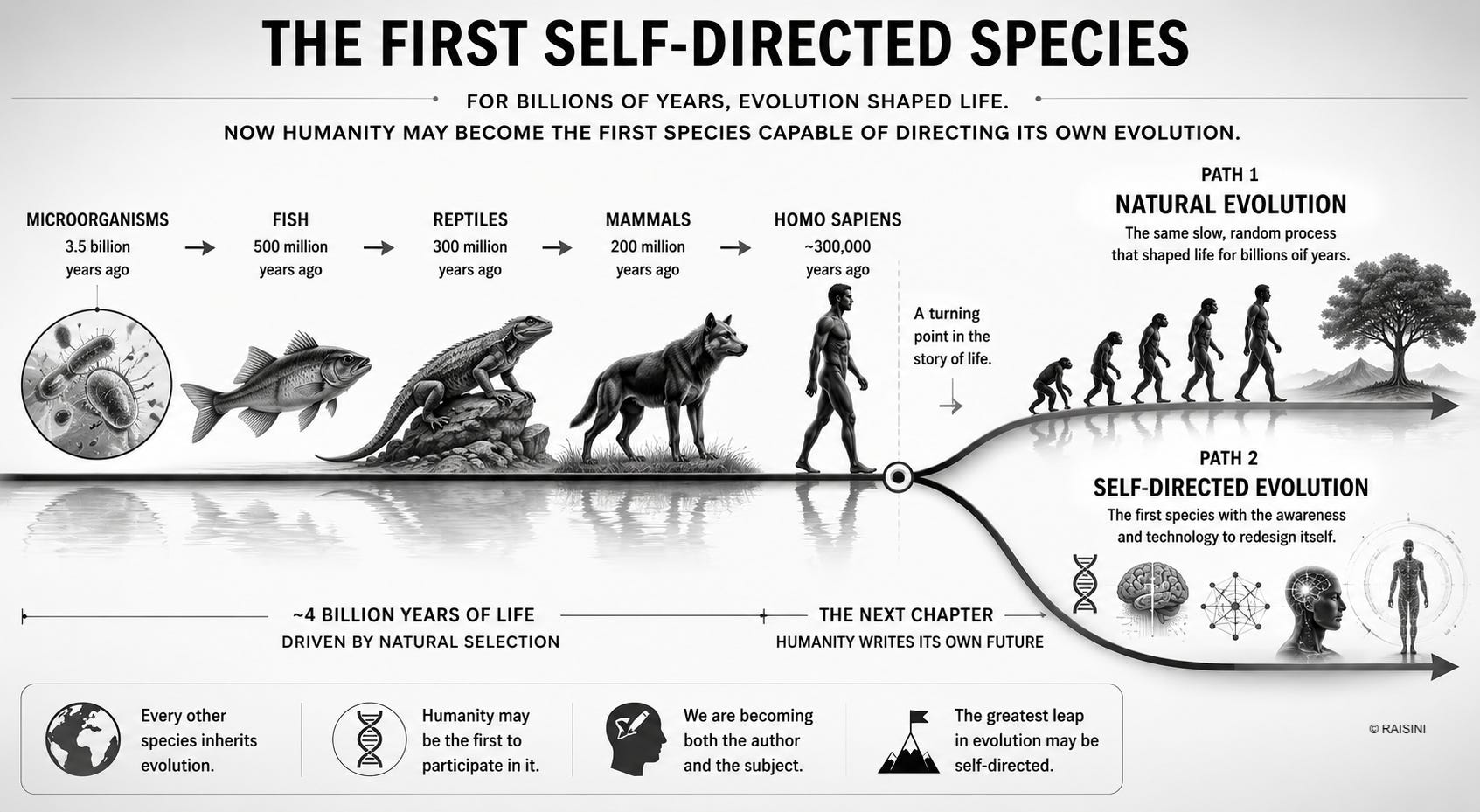
Human beings emerged through the same mechanism. The human brain, the human body, human emotions, social instincts, language, cooperation, competition, and cognition are all products of evolutionary processes that unfolded across hundreds of thousands of years. Like every species before us, we were shaped by circumstances rather than by intention. We inherited the results of evolution, but we did not direct it.
This fact has quietly governed the entire history of civilization. Every empire, religion, political system, economy, and technological achievement was built by a species whose fundamental characteristics were largely inherited. Human beings could alter their environment, but they could not meaningfully alter themselves. They could build cities, roads, governments, and machines. They could not redesign intelligence, rewrite biology, extend lifespan dramatically, or influence the trajectory of their own evolution in any deliberate way.
The technologies explored throughout this essay raise the possibility that this historical pattern may be changing. Artificial intelligence, genetic engineering, synthetic biology, longevity science, and brain-computer interfaces are often discussed as separate innovations. Viewed collectively, however, they point toward a larger shift. For the first time in history, humanity may be acquiring tools capable of influencing aspects of its own development that were previously left to biology and chance.
This possibility represents something deeper than technological progress. Technology has repeatedly changed how human beings live. Agriculture altered settlement patterns. Industry altered production. Electricity altered daily life. Computers altered information processing. Yet these innovations primarily changed the environment within which humans operated. They did not fundamentally change the evolutionary relationship between humanity and its own development.
The emerging technologies discussed in this essay may begin crossing that boundary. Genetics creates the possibility of influencing inherited biological traits. Longevity research seeks to influence processes that evolution never optimized for indefinite survival. Cognitive enhancement technologies aim to influence how intelligence functions. Brain-computer interfaces explore new relationships between biological cognition and external systems. Artificial intelligence may eventually alter how knowledge, expertise, and learning are distributed throughout society.
Individually, each development is significant. Collectively, they suggest that humanity may increasingly participate in shaping characteristics that previous generations simply inherited. The distinction is subtle but profound. Evolution historically determined the capabilities available to human beings. Future human beings may increasingly determine some of those capabilities themselves.
This does not mean that evolution disappears. Natural selection, environmental pressures, biological constraints, and chance will continue influencing human development. Humanity will never exist entirely outside the forces that shaped every previous species. The important observation is that intentional influence may become a larger factor than it has ever been before. Evolution may no longer be the only significant mechanism shaping humanity’s future.
History offers very few examples of comparable transitions because there are none. Earlier technological revolutions altered civilization. This possibility alters the relationship between civilization and the species that creates it. Humanity may increasingly become both the author of change and the subject being changed. The distinction between creator and creation begins to blur.
This possibility also introduces an entirely new category of responsibility. Human beings have spent most of history adapting to conditions they inherited. Future generations may face situations in which they participate directly in determining those conditions. Decisions about biology, cognition, longevity, enhancement, and capability could shape not only individuals, but the trajectory of humanity itself. Questions that once belonged exclusively to nature may increasingly become questions of governance, ethics, incentives, and collective judgment.
The significance of this shift is often obscured by discussions about specific technologies. Public debate tends to focus on products, companies, scientific breakthroughs, and regulatory controversies. Those discussions are important, but they can distract from the larger pattern. The deeper issue is not any individual technology. The deeper issue is that humanity may be approaching a point where it can influence aspects of its own development that previous civilizations treated as fixed.
If that occurs, historians may eventually view the present period differently from how we view it today. They may not see artificial intelligence, genetics, longevity science, or brain-computer interfaces as separate stories. They may see them as early stages of a broader transition in which humanity became capable of participating consciously in its own evolution.
The deepest transition explored throughout this essay may therefore not be technological at all. Technology is merely the mechanism through which it becomes possible. The more significant shift is evolutionary. For billions of years, life adapted to conditions it did not choose. Humanity may become the first species capable of influencing those conditions deliberately. Whether that influence proves wise, beneficial, harmful, or something more complicated remains uncertain. What matters historically is that the possibility exists at all.
For most of history, human beings adapted to reality. The emerging century may be remembered as the period in which humanity began influencing the conditions of its own adaptation. That would mark a transition unlike any previous chapter in the history of life.
What Happens To Civilization When Humans Change?
Throughout this essay, the central observation has been that civilization was built around human limitations. Education, law, economics, family structures, governments, and religions all evolved around assumptions about what human beings could and could not do. If these assumptions begin to weaken, the question is no longer how technology changes society. The question becomes how society adapts when the human foundations upon which it was constructed begin to change.
Throughout this essay, the focus has gradually moved closer to the human being. We began with civilizations, institutions, and technological revolutions. We then explored the possibility that intelligence, biology, lifespan, cognition, and capability themselves may become increasingly modifiable. The next question follows naturally from that progression. If the human organism changes, what happens to the systems built around it?
This question matters because civilizations are not abstract structures floating above humanity. Governments exist because people cooperate imperfectly. Laws exist because judgment is flawed. Education exists because knowledge is not automatically inherited. Economies exist because resources are scarce. Families exist because generations replace one another. Religion exists because human beings confront mortality, uncertainty, suffering, and meaning.
Education provides an obvious example. Modern educational systems assume that learning is slow, memory is limited, expertise is scarce, and knowledge must be transferred gradually across years of instruction. Entire societies organize childhood, adolescence, and early adulthood around these assumptions. If cognition changes significantly, those assumptions may become unstable. A world in which learning can be accelerated, memory enhanced, or intelligence supplemented by advanced systems would raise questions about institutions built around decades-long educational pathways. The challenge would not simply be educational reform. It would be determining what education means when access to knowledge no longer depends entirely on traditional learning.
Law reflects a different set of assumptions. Legal systems are designed around human limitations in judgment, attention, memory, and self-control. Courts exist because facts are disputed. Evidence exists because memory is unreliable. Regulation exists because incentives often produce harmful behavior. If human cognition changes, legal systems may eventually confront questions unlike any they have previously encountered. How should responsibility be assigned when decisions are influenced by cognitive enhancement systems? How should identity be understood when memory and cognition become partially integrated with technology? The details remain uncertain, but the broader point is clear. Law assumes a particular type of human being. If that human changes, legal frameworks may need to change as well.
Work occupies a similarly important position. Modern economies were built upon the assumption that productive labor requires human effort. Industrial societies reorganized work, but they did not eliminate its central role. Human time remained the fundamental input. Yet many of the technologies discussed throughout this essay challenge assumptions about labor itself. Artificial intelligence may alter cognitive work. Robotics may alter physical work. Longevity may alter career timelines. Cognitive enhancement may alter productivity. The issue is not whether work disappears. The issue is whether institutions designed around inherited human limitations continue functioning in the same way when those limitations change.
Economics more broadly may face similar pressures. Economic systems emerged partly because scarcity exists. Resources are limited. Knowledge is limited. Productivity is limited. Human capability is limited. Markets allocate scarcity because scarcity is unavoidable. Yet if intelligence becomes more abundant, if disease becomes less common, if productive capacity increases dramatically, or if lifespan expands significantly, economic assumptions may begin shifting. Scarcity itself is unlikely to disappear, but its location may change. Future economies may revolve around constraints very different from those that shaped previous civilizations.
Inheritance provides another revealing example. Wealth transfer across generations assumes a predictable biological reality. People accumulate resources during life and transfer them after death. Entire financial systems, legal structures, and family arrangements are organized around this cycle. Longevity technologies raise questions that extend far beyond healthcare. If individuals remain healthy and active for much longer periods, patterns of inheritance, wealth concentration, ownership, and social mobility may evolve in ways that are difficult to predict. A civilization built around generational turnover would need to adapt to a world in which turnover occurs more slowly.
Governance may face equally significant challenges. Political systems assume finite human lifespans, limited attention, and relatively stable cognitive abilities. Democracies, bureaucracies, and administrative institutions were developed for populations whose biological characteristics remained broadly consistent across generations. If future populations differ substantially in lifespan, cognition, or capability, political institutions may confront pressures unlike any encountered before. The challenge would not simply involve regulating new technologies. It would involve governing populations whose relationship to time, knowledge, and capability may differ from historical norms.
Religion enters the discussion for similar reasons. Throughout history, religions have addressed questions arising from the human condition. Mortality, suffering, uncertainty, purpose, morality, and transcendence have remained persistent features of human life because the underlying human organism remained relatively stable. If humanity begins altering some of those conditions, religious traditions may face new questions. The search for meaning is unlikely to disappear, but the context within which meaning is pursued may evolve. Questions that once belonged entirely to theology may increasingly intersect with biology and technology.
Family structures may undergo comparable transformations. Families exist partly because human beings reproduce, age, depend on caregivers, and eventually die. These biological realities create recognizable social patterns across civilizations. Expanded lifespan, changing reproductive technologies, and altered generational timelines could influence family structures in ways that extend far beyond individual households. The family has historically been one of civilization’s most durable institutions because it emerged from stable biological conditions. Changes to those conditions inevitably create pressure for adaptation.
What unites all of these examples is a simple observation. Civilizations are built around recurring features of human nature. Institutions emerge because they are built upon recurring features of the human condition. They are, in effect, civilization’s infrastructure for managing human limitations. Most political debates focus on changing institutions while assuming the human being remains constant. The possibility explored throughout this essay reverses that relationship.
The answer is unlikely to be simple. Institutions rarely transform overnight. Most evolve gradually in response to shifting conditions. Yet history suggests that when foundational assumptions change, civilizations eventually change with them. The printing press altered knowledge systems. Industry altered economic systems. Digital networks altered information systems. If human limitations themselves become increasingly modifiable, then the institutions built around those limitations may eventually face pressures unlike anything seen before.
The deeper implication is that the future may involve more than technological transformation. It may involve institutional transformation on a civilizational scale. Education, law, work, economics, inheritance, governance, religion, and family were all built around a particular type of human being. If that human changes, civilization may have no choice but to change as well.
The New Inequality
Throughout most of modern history, discussions about inequality have focused on the distribution of resources. Wealth, income, property, education, political influence, and opportunity have dominated public debate. These concerns remain important because access to resources shapes life outcomes in profound ways. Yet the technologies explored throughout this essay raise the possibility that future inequalities may emerge in a different form. The most significant divide may not be between those who possess more wealth and those who possess less. It may be between those who possess greater capabilities and those who do not.
This distinction matters because wealth inequality and capability inequality operate according to different mechanisms. Wealth influences what people can acquire. Capability influences what people can become. The difference is subtle but profound. A society can tolerate significant differences in income while still assuming that its citizens share roughly the same biological and cognitive foundation. Future enhancement technologies challenge that assumption.
For most of history, human capabilities existed within a relatively narrow range. Some individuals were healthier than others. Some were more intelligent. Some enjoyed better education, nutrition, or living conditions. Yet the underlying human organism remained broadly comparable. A king and a peasant differed enormously in status and resources, but they shared the same biological vulnerabilities. They aged. They became ill. They forgot. They died. Their differences existed within a common human framework.
The possibility explored throughout this essay is that future technologies may widen those differences in ways that extend beyond traditional measures of wealth. If cognitive enhancement becomes possible, some individuals may gain access before others. If longevity treatments become effective, some populations may benefit earlier than others. If genetic engineering expands, some families may acquire capabilities unavailable elsewhere. If advanced artificial intelligence becomes deeply integrated into decision-making and productivity, access itself may become a source of advantage.
The important issue is not whether such technologies become universally available immediately. History suggests that transformative technologies rarely do. Access typically begins unevenly. New capabilities emerge first within specific institutions, industries, regions, or socioeconomic groups before gradually spreading more broadly. Electricity followed this pattern. Higher education followed this pattern. Digital technology followed this pattern. Human enhancement technologies may follow it as well.
What makes this possibility significant is that the inequality involved concerns capability rather than possession. Economic inequality influences opportunities. Capability inequality may influence the ability to create opportunities in the first place. Enhanced cognition could influence learning speed, decision-making, problem-solving, and productivity. Longevity could influence experience accumulation, wealth retention, and institutional influence. Biological enhancement could affect health, resilience, and performance. The result may be differences that extend beyond conventional economic categories.
This creates a feedback loop that previous forms of inequality did not fully possess. Wealth often generates additional wealth. Capability may generate additional capability. Individuals with enhanced cognitive abilities may learn faster, adapt more quickly, and make better use of available resources. Those advantages can compound over time. The issue is not merely that some people possess more. The issue is that some people may become increasingly capable of acquiring more.
The implications extend beyond individuals. Entire organizations, industries, and nations may face similar dynamics. Countries that gain early access to transformative technologies may strengthen their economic and strategic positions. Institutions capable of integrating advanced capabilities effectively may outperform those that cannot. Competitive advantages could emerge not simply from access to resources, but from access to enhanced human performance itself.
This possibility introduces difficult questions about fairness and social stability. Modern societies generally accept that people differ in talent, effort, and circumstance. They also tend to assume that citizens share a common human foundation beneath those differences. If enhancement technologies create meaningful divergence in capability, maintaining that shared foundation may become more difficult. Political systems designed around relatively equal human vulnerability may face pressures they have never encountered before.
Importantly, this chapter is not predicting a future divided neatly into enhanced and unenhanced populations. Reality is unlikely to be so simple. Access will probably exist along a spectrum. Different technologies will mature at different rates. Some enhancements may prove effective while others fail. Adoption may vary across cultures and societies. The broader point is not the specific form inequality takes. The broader point is that the source of inequality may change.
Historically, debates about inequality focused on who owned land, capital, education, or information. Future debates may increasingly focus on who possesses access to enhanced cognition, extended lifespan, superior health, advanced biological interventions, or integrated intelligence systems. The conversation shifts from what people have to what people are capable of becoming.
This distinction may ultimately prove more consequential than traditional economic divisions. Wealth can sometimes be redistributed. Capability is more complex. Differences in cognition, health, lifespan, and biological performance influence outcomes across entire lifetimes. They affect education, employment, relationships, leadership, innovation, and influence simultaneously. A society characterized by significant capability gaps may experience forms of stratification unlike those encountered before.
The possibility explored throughout this essay is not that inequality disappears. History provides little evidence for such an outcome. The possibility is that inequality evolves. As humanity gains increasing influence over intelligence, biology, cognition, and longevity, the most important divides of the future may concern access to human capability itself.
For centuries, societies argued about the unequal distribution of resources. The coming century may force societies to confront a different question entirely. What happens when the thing distributed unequally is not wealth, but capability?
The Reinvention Of Human Identity
Most of the questions explored throughout this essay have been practical, structural, or civilizational. We have examined intelligence, biology, longevity, governance, inequality, and power. Yet beneath all of those discussions lies a deeper question that is both older and more difficult. If humanity begins altering intelligence, memory, cognition, lifespan, and biology itself, what happens to the idea of being human?
This question has occupied philosophers, theologians, and thinkers for thousands of years because human identity has never been as straightforward as it appears. Most people intuitively feel that they possess a stable self. There is a sense of continuity that persists from childhood through adulthood despite constant change. Bodies age. Knowledge accumulates. Beliefs evolve. Relationships come and go. Yet individuals generally experience themselves as the same person moving through time. Civilization itself is built upon this assumption. Law, morality, responsibility, relationships, and social trust all depend upon the idea that a recognizable person persists across changing circumstances.
The difficulty is that human identity has always been more fragile than it appears. Biology constantly replaces cells throughout the body. Memories fade, distort, and reconstruct themselves. Personality can change after trauma, illness, injury, or age. Human beings are not fixed objects but ongoing processes. The continuity people experience often depends less on permanence than on the brain’s ability to maintain a coherent narrative about who they are.
Memory plays a particularly important role in this process. Much of what individuals call identity is built from remembered experience. Personal history creates continuity. Relationships create continuity. Shared stories create continuity. The self often feels stable because memory stitches together countless moments into a single narrative thread. Remove memory and identity begins to fracture. Severe forms of amnesia demonstrate how closely personhood is tied to remembered experience. When memory changes dramatically, the individual remains biologically present, yet something essential appears altered.
The technologies discussed throughout this essay may place unusual pressure on these assumptions. Brain-computer interfaces, cognitive enhancement systems, artificial intelligence integration, and future forms of memory augmentation all raise questions about where identity resides. If memories can be externally stored, enhanced, supplemented, or accessed through technological systems, what becomes of the traditional relationship between memory and selfhood? If cognition increasingly operates through partnerships between biological and digital systems, where does the individual end and the tool begin?
These questions may sound abstract today, but they emerge naturally from the trajectory explored throughout this essay. Earlier technologies extended human capability without fundamentally altering the relationship between mind and self. A calculator improved arithmetic. A computer improved information processing. The internet improved access to knowledge. Yet the individual remained clearly separate from the technology being used. Future systems may blur that distinction. The boundary between internal cognition and external capability could become increasingly difficult to define.
Consciousness introduces an even deeper challenge. Human beings understand remarkably little about consciousness despite centuries of study. People experience awareness directly, yet the mechanisms underlying that awareness remain one of the most persistent mysteries in science and philosophy. Future technologies capable of influencing cognition, memory, perception, or neural activity may force civilization to revisit questions that were previously confined to philosophy. What exactly constitutes a conscious self? Which aspects of identity are essential, and which are merely inherited assumptions?
Personhood may become similarly difficult to define. Modern legal and moral systems assume that individuals are discrete entities possessing agency, responsibility, and continuity. These assumptions function well because human beings currently share broadly similar cognitive and biological characteristics. Future enhancement technologies could complicate these categories. If cognition becomes increasingly augmented, if memory becomes partially externalized, or if biological modification becomes commonplace, existing definitions of personhood may encounter situations they were never designed to address.
The issue is not whether humanity ceases to be human. Human beings have incorporated new technologies throughout history without losing their identity. Writing altered memory. Printing altered knowledge. Digital systems altered communication. Humanity remained recognizable through each transformation. The more important question is whether future technologies alter dimensions of human experience that previous technologies largely left untouched. Intelligence, memory, cognition, and lifespan occupy a different category from transportation, communication, or manufacturing. They sit closer to the foundations of identity itself.
This is why the discussion ultimately returns to a question far older than technology. Throughout history, human beings have repeatedly attempted to understand what they are. Religions approached the question through the soul. Philosophers approached it through reason and consciousness. Scientists approached it through biology and neuroscience. None produced a final answer. The mystery persisted because human beings could observe themselves but possessed limited ability to alter the underlying mechanisms involved.
The coming century may introduce a new situation. Humanity may begin modifying aspects of itself that previous civilizations simply inherited. The significance of that possibility extends beyond capability. It reaches into the nature of identity itself. Questions that once belonged primarily to philosophy may increasingly become practical questions of governance, technology, medicine, and social organization.
The deeper implication is that the future may challenge more than human limitations. It may challenge human definitions. The next century may force civilization to confront questions that earlier generations could largely avoid. What makes a person the same person over time? How much change can identity absorb before continuity breaks? What aspects of humanity are essential, and which are simply products of historical circumstance?
The technologies explored throughout this essay do not merely raise questions about what humans can do. They raise questions about what humans are. That distinction may prove far more important than any individual technological breakthrough.
The Last Human Generation
The title of this essay can easily be misunderstood.
“The Last Human Generation” does not imply extinction. It does not predict the collapse of civilization. It does not suggest that machines will replace humanity or that human beings are approaching some inevitable technological apocalypse.
The argument is considerably narrower than that, but potentially far more significant.
What makes the coming century historically unusual is not that civilization is changing. Civilization has always changed. Every generation has experienced new technologies, new institutions, new forms of power, and new ways of organizing society. Change is the normal condition of history.
What may be different is that humanity itself is beginning to enter the innovation cycle.
For thousands of years, human beings adapted to conditions they inherited. They inherited mortality, aging, biological limitations, cognitive constraints, disease, and the physical architecture of the human body. Civilizations evolved around those realities because those realities appeared fixed. The role of institutions was not to alter the human condition but to help societies function within it.
Today, that assumption appears less certain.
Artificial intelligence, genetic engineering, longevity science, synthetic biology, robotics, and brain-computer interfaces are not important merely because they create new tools. Their deeper significance is that they increasingly target characteristics previous civilizations treated as permanent features of existence. Intelligence, memory, aging, biological inheritance, disease, and physical capability are increasingly being approached not simply as realities to manage but as variables that may be influenced, optimized, or redesigned.
Whether these technologies ultimately achieve their most ambitious goals remains unknown. History is filled with predictions that never materialized, technical barriers that proved more difficult than expected, and breakthroughs that arrived decades later than anticipated. Some developments may advance rapidly. Others may encounter economic, political, ethical, or scientific constraints that slow progress for generations.
The purpose of this essay is not to forecast specific outcomes. The deeper observation is that humanity has already begun moving into unfamiliar territory. For the first time in history, serious scientific and technological effort is being directed toward aspects of human existence that previous civilizations largely accepted as fixed. The significance lies not only in what may eventually be achieved but in what humanity is now attempting to change.
This shift may prove more important than any individual breakthrough. A powerful artificial intelligence system, a major advance in longevity science, or a revolutionary genetic technology would each be significant developments. Yet viewed across centuries, they may ultimately be remembered as manifestations of a larger transition. The deeper change is that humanity is beginning to acquire tools capable of influencing characteristics that once sat beyond the reach of civilization itself.
If that process continues, its consequences will extend far beyond science and technology. Every major institution discussed throughout this essay emerged within a world defined by biological constraints. Education developed because knowledge had to be learned. Economies developed because intelligence, labor, and attention were scarce. Governments developed because generations died and required replacement. Healthcare developed because disease and aging were unavoidable. Religious traditions developed because mortality, suffering, uncertainty, and meaning-seeking were universal human experiences.
These institutions were built around assumptions regarding what human beings were.
The question emerging now is what happens if some of those assumptions begin to change.
If intelligence becomes less scarce, if aging becomes more controllable, if biology becomes more editable, and if cognition becomes increasingly integrated with machines, then civilization will eventually be forced to adapt. Not because societies are changing, but because the organism around which societies were built may be changing as well.
This is why the phrase “The Last Human Generation” should be understood as a historical possibility rather than a prediction. It points toward a potential boundary in the human story. For thousands of years, every generation inherited essentially the same biological framework. Future generations may inherit a framework that is increasingly shaped by intervention, modification, and design.
The scale of that change remains uncertain. The timeline remains uncertain. Even the direction remains uncertain. What appears increasingly difficult to dismiss, however, is the possibility that humanity is entering a period unlike any that came before it.
Not because technology is advancing. Technology has always advanced.
Not because societies are changing. Societies have always changed.
But because the stable human organism that existed beneath every previous civilization may itself be becoming part of the innovation cycle.
The Prophecy Instinct
Periods of rapid change have a tendency to produce prophecies.
This pattern appears repeatedly throughout history. Ancient civilizations imagined world-ending catastrophes. Religious traditions developed visions of final judgments, apocalypses, and transformative ages yet to come. Political movements often predicted the arrival of perfect societies or inevitable collapses. Modern culture continues the same habit through different language. The underlying impulse remains remarkably consistent.
Whenever human beings encounter uncertainty on a sufficiently large scale, they begin constructing stories about what comes next.
Part of this tendency emerges from a simple cognitive reality. Human beings are uncomfortable with uncertainty. Ambiguity leaves decisions unresolved and futures undefined. The mind naturally attempts to transform uncertainty into something more manageable. One way of doing this is through prediction. Another is through narrative. When uncertainty becomes large enough, prediction and narrative often merge into prophecy.
The important distinction is that prophecy is not merely a forecast. Forecasts acknowledge uncertainty. Prophecies reduce uncertainty by presenting a particular future as inevitable. They provide psychological clarity even when empirical certainty is unavailable.
Throughout history, both optimistic and pessimistic prophecies have emerged from the same mechanism. Some generations become convinced that civilization is approaching collapse. Others become convinced that humanity stands on the threshold of unprecedented prosperity and transformation. Despite their differences, both narratives serve a similar function. They convert complex possibilities into coherent stories that make uncertainty easier to understand.
The modern conversation surrounding artificial intelligence illustrates this pattern clearly. One group imagines a future in which intelligent systems solve humanity’s most persistent problems, eliminate scarcity, accelerate scientific discovery, and usher in an era of abundance. Another imagines a future defined by mass unemployment, loss of control, social collapse, or even human extinction. Both visions receive significant attention because they transform uncertainty into certainty.
Yet reality rarely unfolds according to prophecy.
History is filled with futures that never arrived. Predicted utopias failed to materialize. Predicted catastrophes never occurred. More often, societies experienced outcomes that were simultaneously more ordinary and more complicated than either side anticipated. Technological revolutions created new opportunities while generating new problems. Social transformations solved certain constraints while introducing others. The future rarely conforms to the simplicity of the stories created about it.
This does not mean that concerns about emerging technologies should be dismissed. The questions explored throughout this essay are real and significant. Artificial intelligence, biotechnology, longevity science, and related fields may reshape civilization in profound ways. The challenge is that profound uncertainty should not be mistaken for certainty about outcomes.
Understanding the prophecy instinct becomes particularly important during periods of transformation because it encourages intellectual humility. Human beings have always struggled to distinguish between what might happen and what must happen. The larger the change appears, the stronger the temptation becomes to treat possibilities as inevitabilities.
The future discussed throughout this essay remains unwritten. Humanity may navigate these transitions successfully. It may encounter difficulties that are currently difficult to imagine. Most likely, it will experience a mixture of both. What history suggests with some confidence is that radical uncertainty often tells us as much about human psychology as it does about the future itself.
When confronted with an unfamiliar horizon, human beings rarely tolerate not knowing. We instinctively reach for certainty. Prophecy, in many forms, is often the result.
A New Chapter In The Human Story
History is usually told through civilizations.
We divide the past into recognizable chapters. Ancient Egypt. Classical Greece. Imperial Rome. The dynasties of China. The rise of Europe. The Industrial Revolution. The modern digital age. Each period appears distinct because each developed different institutions, technologies, belief systems, and forms of social organization. The visible features of civilization changed constantly, creating the impression that history is primarily a story of transformation.
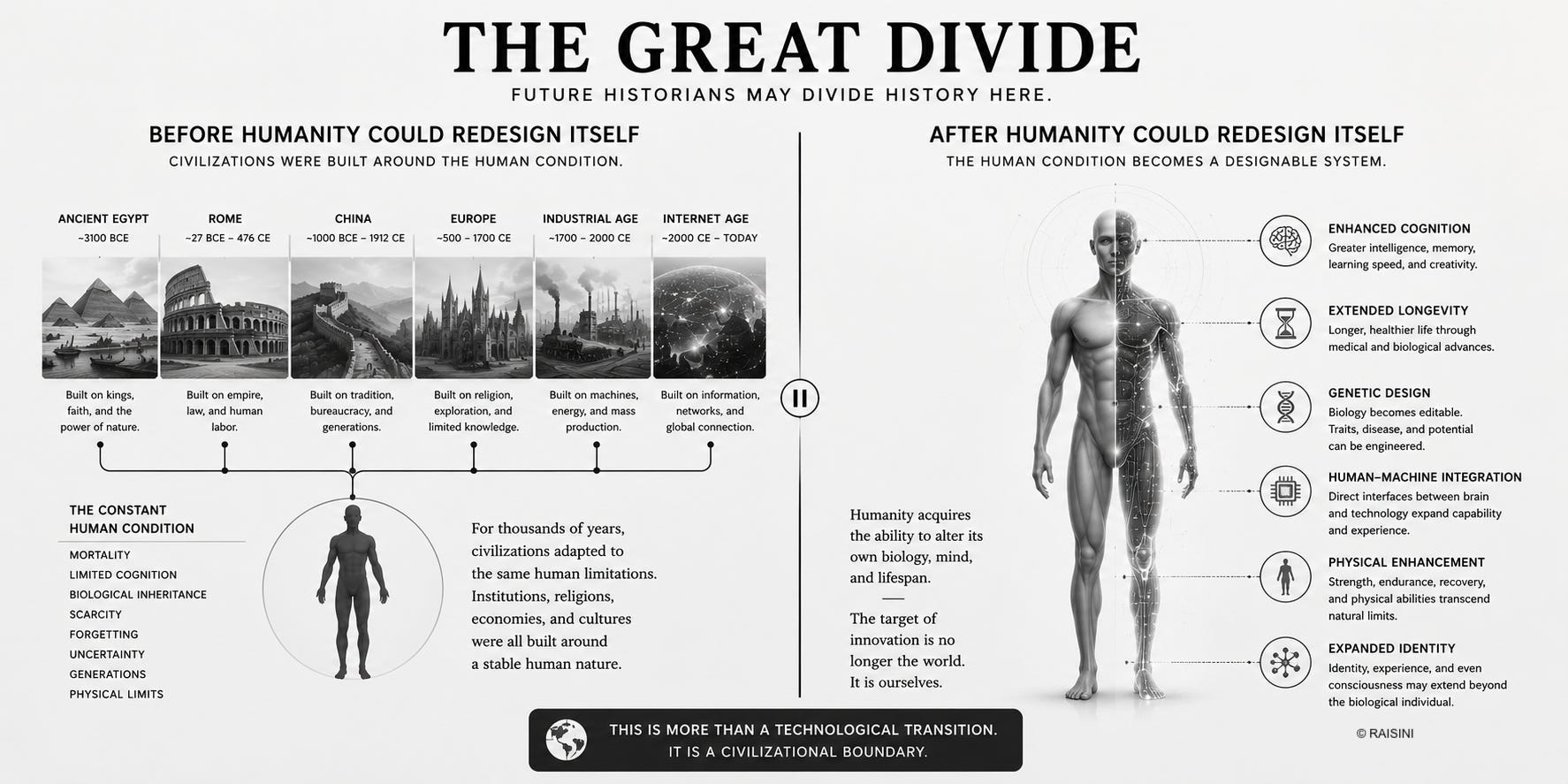
Yet beneath those transformations existed a remarkable continuity.
Much of this essay has focused on technologies that are often discussed independently. Artificial intelligence, genetics, longevity science, synthetic biology, robotics, and brain-computer interfaces are usually treated as separate fields with separate implications. Viewed from a sufficiently long historical perspective, however, they may represent aspects of a larger transition. What unites them is not their technical architecture but their shared destination. Increasingly, they direct innovation toward the human being itself.
This is why the central question explored throughout these pages is not whether technology will continue changing the world. Technology has always changed the world. Every major period of civilization was shaped by technologies that transformed the environment in which people lived.
The possibility examined here is different.
For most of history, humanity modified its surroundings while remaining largely unchanged itself. The tools became more sophisticated. The systems became more complex. The scale of civilization expanded. Yet the biological creature at the center of those systems remained remarkably familiar across generations. Human beings adapted to the world they inherited, even as they worked to reshape parts of it.
The emerging technologies of the twenty-first century introduce a different possibility. They increasingly raise the prospect that the object of innovation is no longer limited to the environment surrounding humanity. The object of innovation may increasingly become humanity itself.
Whether this transformation unfolds gradually or rapidly remains uncertain. Whether its consequences prove beneficial, harmful, or mixed remains uncertain. Whether many of the ambitions associated with these technologies ultimately succeed remains uncertain. The future described throughout this essay is not a forecast. It is a possibility emerging from the direction of present trends.
What appears increasingly difficult to dismiss is that humanity may be approaching a threshold that previous civilizations never encountered. Earlier generations could transform landscapes, institutions, economies, and technologies. They could not meaningfully alter the biological assumptions around which civilization itself was organized. Those assumptions remained fixed. Mortality remained fixed. Aging remained fixed. Biological inheritance remained fixed. Cognitive limitations remained fixed. Human beings could respond to these realities, but they could not substantially redesign them.
That distinction may prove historically significant.
Future historians may not ultimately divide history according to kingdoms, nations, religions, economic systems, or even technological eras. Those categories may remain important, but they may no longer represent the deepest dividing lines in the human story. From a sufficiently distant perspective, a more fundamental distinction may emerge.
There was a period in which humanity could not meaningfully redesign itself.
And there was a period in which it could.
If such a division eventually appears, the transition may not be obvious to those living through it. Historical boundaries rarely announce themselves in advance. Most become visible only in retrospect, when later generations look backward and recognize that an assumption once considered permanent had quietly ceased to be true.
The assumption explored throughout this essay is the assumption of a stable human organism. Every civilization inherited it. Every institution depended upon it. Every generation organized its world around it.
For thousands of years, humanity changed the world while remaining largely constrained by the same biological realities.
The possibility now emerging is that those realities themselves may become increasingly subject to intervention, modification, and design.
Every previous generation inherited humanity.
Future generations may inherit modified versions of humanity.
If that happens, we may not be remembered as the generation that built the future.
We may be remembered as the last generation that was simply born human.
— Raisini
If you enjoyed this essay, please show your support by donating and help spread this story with a friend to help them find their purpose.
See you next week,
RAISINI
👉🏻 Connect on LinkedIn - LEONIDAS RAISINI
👉🏻 Listen to my music - RAISINI
👉🏻 Work with me - www.LeonidasRaisini.com
Founding Member
You can also become a founding member, where you will get a 15 Minutes consultation call with me, have access to super exclusive stories including access to my new Music before others, meet in person (if we are in the same city), invite to our events. All for $150 per year. [This is also a great option if you happen to have, say, an employer-sponsored reading or education budget.]
Copyright RAISINI 2026. Any illegal reproduction of this content will result in immediate legal action.
The saved turtle posted is not responding to restacks, likes, or comments.