

Why Do We Pay to Exist?
The hidden assumption we inherit without ever questioning.

Welcome to this week’s issue of RAISINI.
Every week, I write about understanding how reality actually works - from human nature and decision-making to power, wealth, entrepreneurship, investing, health, and the invisible systems that shape our lives. This isn’t theory. It’s what I’ve lived. Let’s keep going.
If you want access to private chats, live events, workshops, and more, consider becoming a paid or founding member.
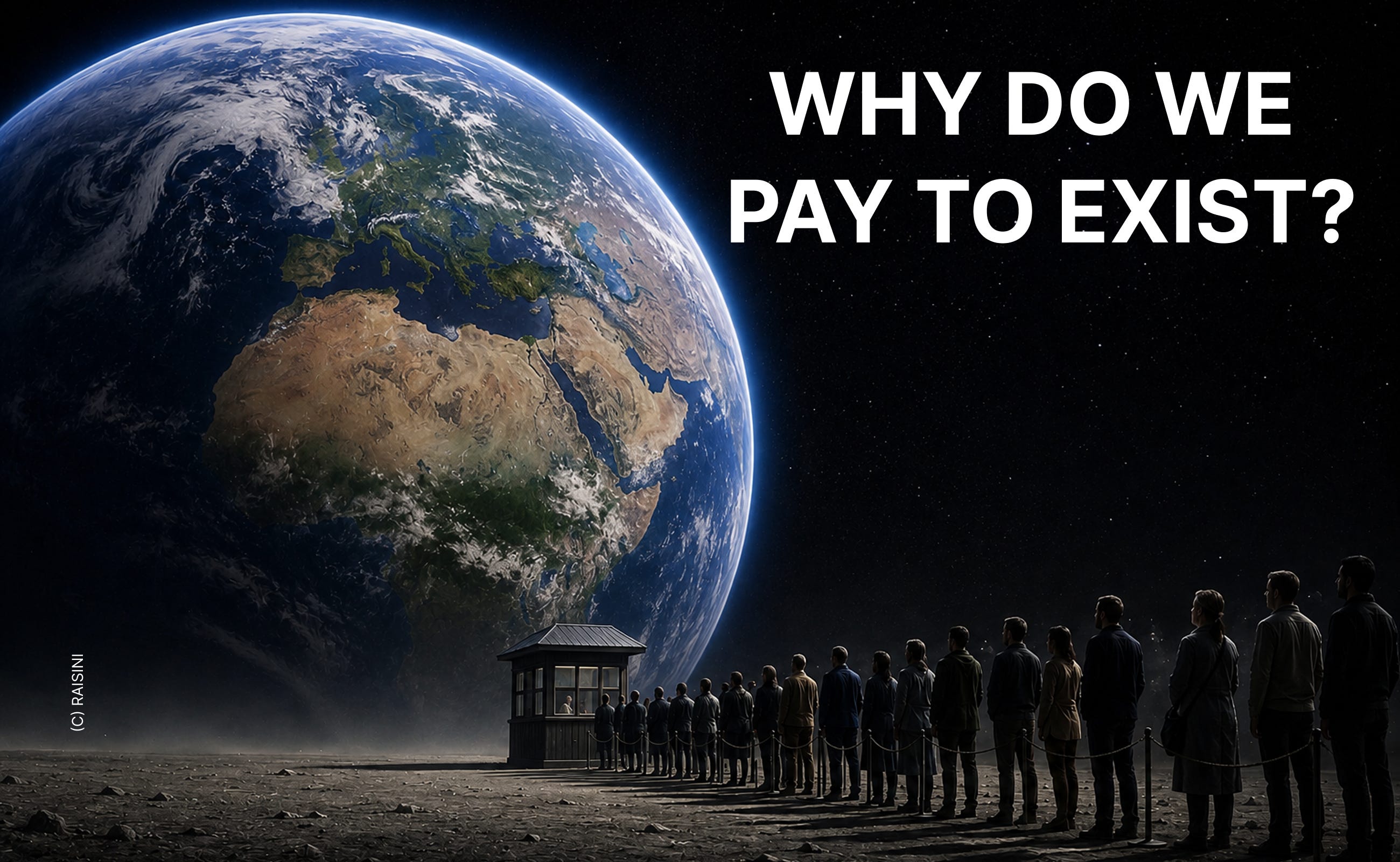
Why do we pay to exist?
Every human being arrives in the world needing the same basic things: water, food, shelter and a place to exist. Yet from the moment we begin making our own way through life, almost every one of those necessities already belongs to someone else. We inherit a world where land has owners, water has bills, homes have prices and even the simplest acts of living pass through systems that long predate us. Because this is the only world we have ever known, we rarely stop to ask the obvious question.
How did we get here?
The answer isn’t found in a single king, empire or invention. It unfolds across thousands of years of human history, from the first settlements and the rise of agriculture to the emergence of ownership, money, taxation and governments. None of it happened overnight, and none of it happened without reason. But somewhere along that journey, humanity’s relationship with the Earth changed forever.
The Only Species That Pays to Exist
A deer lowers its head to drink from a river. It does not pause to consider who owns the water or whether it has permission to approach the bank.
A bird gathers twigs from nearby trees and patiently builds a nest.
A fox digs a den into the earth, finding shelter where the landscape allows.
Across forests, deserts, mountains and oceans, countless species spend their lives searching for food, finding water and creating places of safety. Survival is rarely easy, and nature offers no guarantees, but access to these necessities comes directly through the environment itself.
None of these animals receives an invoice. None signs a contract before building a home. None pays rent to occupy a piece of land or purchases the right to drink from a stream. Their existence depends on their ability to survive within nature, not on navigating institutions created by their own species.
Humans share the same biological starting point.
Every newborn child enters the world needing water, food, warmth, shelter and protection. The needs are no different from those of any other mammal. Long before language develops or culture begins to shape identity, those basic requirements are already present. They are not inventions of civilization but conditions of life itself.
Yet the world that child inherits is profoundly different.
Before reaching adulthood, almost every necessity of life has become connected to systems that existed long before they were born. A home is purchased or rented. Land belongs to someone. Water arrives through infrastructure that must be maintained. Electricity is generated, distributed and billed. Education takes place within organized institutions. Healthcare is delivered through structured systems. Even moving from one place to another often requires licenses, registration or payment. Access to the conditions that make life possible is rarely immediate. It is usually mediated through networks of ownership, law, markets and government that have evolved over thousands of years.
Because every generation is born into these arrangements, they appear as ordinary features of reality rather than historical developments. We learn how to participate in them before we are old enough to question where they came from. Paying for shelter, earning money to buy food and navigating legal and economic institutions become part of everyday life. Their familiarity makes them almost invisible.
None of this suggests that civilization has made life worse or that earlier societies were easier places to live. On the contrary, the institutions that shape modern life emerged because they solved real problems, allowing communities to grow, economies to develop and societies to become more stable and complex. The modern world is the product of countless generations adapting to new challenges and creating new ways of organizing themselves.
But recognizing that these institutions evolved raises a question that is surprisingly easy to overlook. If every human being arrives on the same planet as every other living species, when did access to life’s most basic necessities stop being immediate and start passing through institutions? Understanding the answer requires looking far beyond modern economics or politics. It requires tracing one of the longest stories in human history: how civilization gradually transformed humanity’s relationship with the Earth itself.
The Invoice We Never Question
Most people rarely think about the systems that make everyday life possible. We think about work, family, deadlines and plans for the future, but the structure supporting those ordinary experiences often goes unnoticed. Like the foundations beneath a building, it is easiest to overlook what is always there. Only when something stops working do we become aware of how much of life depends on arrangements we seldom question.
Consider shelter, one of the most basic human needs. Every person requires protection from the elements, whether from cold winters, intense heat or heavy rain. Yet access to shelter almost always passes through institutions. Some people rent a home. Others purchase one through a mortgage that may take decades to repay. Even after ownership is established, there are often continuing obligations such as council tax or other property-related charges that help support local services. A home is not simply a physical structure. It exists within a wider framework of agreements, records and responsibilities.
Movement follows a similar pattern. Humans have always travelled in search of opportunity, resources and connection. Today, moving across the landscape is supported by vast transport networks, but participation in those networks involves more than simply deciding to travel. Driving typically requires a license, vehicles must usually be registered, fuel is purchased through commercial markets and insurance forms part of the legal framework in many countries. Each element represents an organized system that enables millions of people to travel safely and predictably every day.
The same pattern extends to the essentials of daily living. Food reaches homes through farmers, processors, distributors, retailers and countless other participants connected by markets and supply chains. Water arrives through reservoirs, treatment facilities and distribution networks that require continual maintenance. Electricity is generated, transmitted and supplied through infrastructure spanning entire regions. Heating depends on energy systems built over generations, whether through gas, electricity or other sources. Few people gather these necessities directly from the natural environment. Instead, they access them through institutions that coordinate production, infrastructure and exchange on an enormous scale.
Participation in modern society also depends on systems that previous generations gradually developed. Education introduces children to knowledge accumulated over centuries through organized schools, universities and training institutions. Healthcare combines scientific understanding, skilled professionals, hospitals and public or private organizations to diagnose illness and improve health.
Communication, once limited by physical distance, now relies upon extensive networks of cables, satellites, mobile infrastructure and digital platforms that allow information to travel almost instantly across the world. These systems have become so reliable that many of us notice them only when they fail.
Seen individually, each arrangement appears entirely ordinary. Renting a home, paying an electricity bill, renewing a driving license or enrolling a child in school are simply part of everyday life. We approach each task as a separate responsibility, rarely considering that together they reveal something much larger. Almost every necessity of modern existence is accessed through institutions that organize, regulate or coordinate our relationship with the resources we depend upon.
This observation is not a criticism of modern civilization. These institutions provide remarkable levels of stability, cooperation and scale that would be impossible for individuals to achieve alone. Clean water reaches millions of homes each day. Roads connect distant communities. Hospitals perform procedures that earlier generations could scarcely imagine. Markets distribute food across continents. The point is not that these systems exist, but that they have become so familiar we often mistake them for natural features of human existence rather than historical developments.
A child born today does not invent any of these arrangements. They inherit them. Long before they earn their first wage, sign their first contract or pay their first bill, the frameworks governing shelter, movement, daily living and participation in society are already waiting for them. They enter a world whose institutions were built by countless generations before their own.
None of these feel unusual because we inherited them.
Before Ownership
If the modern world feels inseparable from ownership, it is only because we have lived our entire lives within it. To understand how humanity came to organize life through institutions, we first need to step back to a time before those institutions existed.
For almost all of our species’ history, human beings lived as hunter-gatherers. Long before cities, governments or written laws, small groups moved through forests, grasslands, coastlines and river valleys, relying on their knowledge of the natural world to survive. They hunted animals, gathered edible plants, caught fish, collected fruit and followed the changing rhythms of the seasons. Their lives demanded skill, cooperation and constant adaptation, but they unfolded within landscapes that had not yet been divided into the kinds of permanent ownership familiar today.
This was not an easier way of life. Finding enough food was a daily challenge. Weather could destroy resources without warning. Injuries that are now easily treated could become fatal. Predators competed for the same territory, and long periods of drought or harsh winters could threaten entire communities. Survival depended upon experience, physical endurance and a detailed understanding of the environment. Every day required effort.
Work, therefore, is not a product of civilization. Humans have always worked. The difference lay in the nature of that work and the relationship it created with the world around them.
A hunter did not receive food because it had been purchased. They received food because they successfully tracked and caught an animal. A family did not drink because water arrived through pipes connected to distant reservoirs. They drank because they reached a river, a spring or a lake. Shelter came from caves, temporary structures or materials gathered from the surrounding landscape. Survival depended primarily on the ability to engage directly with nature rather than with institutions.
Many hunter-gatherer societies were also nomadic or semi-nomadic. Rather than remaining in one place throughout the year, they moved as seasons changed and resources shifted. If game migrated, they followed. If water became scarce, they travelled elsewhere. The landscape was not understood as a collection of fixed properties separated by fences and legal boundaries. It was an environment to be navigated, understood and shared according to the opportunities and constraints that nature presented.
This does not mean there were no customs, traditions or social rules. Human beings have always organized themselves into communities with expectations about cooperation, leadership and responsibility. But these arrangements were fundamentally different from the institutional systems that shape modern life. Access to survival depended far more on knowledge of the natural world than on formal structures governing ownership or exchange.
The contrast with the present is striking. Today, many people can spend their entire lives without personally gathering food, finding fresh water or building their own shelter. Instead, they participate in systems that perform these functions collectively. The direct relationship between humans and nature has, for the most part, been replaced by relationships with institutions that organize access to those same necessities.
Looking back across thousands of generations reveals how unfamiliar many modern assumptions would have seemed to our distant ancestors. Nobody carried a legal deed establishing ownership of a river. Nobody purchased the right to breathe the air above a valley. Nobody sold the sky. Nature could be harsh, unpredictable and unforgiving, but it was not yet organized through the extensive frameworks of ownership that define so much of contemporary life.
This way of living continued for tens of thousands of years. Then, gradually and in different places across the world, humanity began making one of the most significant transitions in its history. Instead of moving with the landscape, some communities started to remain in one place. They cultivated crops, domesticated animals and invested their labour in specific pieces of land. What had once been temporary became increasingly permanent.
Agriculture did far more than change how people found food. It began changing humanity’s relationship with the Earth itself, laying the foundations for ownership, boundaries and the institutions that would eventually shape every generation that followed.
When Did the Earth Become Ownable?
For most of human history, the relationship between people and the natural world was based on movement, adaptation and immediate access. Human communities depended on their ability to understand their surroundings and respond to changing conditions. They followed animal migrations, collected seasonal resources and moved when the environment could no longer support them. Land was important, but it was not usually understood in the modern sense as something that could be permanently owned, transferred or inherited.
The agricultural revolution began to change this relationship. When some human societies started cultivating crops and domesticating animals, they created a different connection with the places where they lived. Farming required preparation, patience and repeated investment. Seeds had to be planted, fields maintained and harvests protected. Unlike hunting or gathering, where people could move according to the availability of resources, agriculture encouraged people to remain connected to particular areas over long periods of time.
This created a new form of value. The importance of a piece of land was no longer determined only by what nature immediately provided. It became connected to the effort humans had invested into improving it. A field represented months or years of work. A successful harvest depended not only on the qualities of the soil but also on the knowledge, labour and organization of the people cultivating it.
Once human effort became embedded in specific places, a new problem emerged: security. A community that invested significant time into preparing land needed some confidence that the benefits of that work would remain available to them. If people could cultivate an area for months and then lose access to it without any recognized rules, the incentive to invest would be reduced. Ownership began to develop not because humans suddenly became interested in possession for its own sake, but because settled communities needed ways to create stability around the resources they depended upon.
Permanent settlements expanded this challenge. As villages grew, more people began sharing the same geographical areas and relying on the same resources. Cooperation became increasingly important, but so did coordination. Communities needed ways to understand responsibilities, resolve disagreements and create expectations about who could use particular resources and under what conditions.
The development of stored food made these questions even more important. Agriculture allowed societies to produce surpluses that could be preserved for future use. Stored grain helped communities survive periods when harvests failed or resources became scarce. However, once resources could be accumulated, societies needed systems to manage them. Questions naturally emerged around production, protection and distribution. Who had contributed to creating the surplus? Who was responsible for maintaining it? Who could access it during difficult times?
These challenges encouraged humans to create more permanent social arrangements. One of the most important was inheritance. When individuals spent their lives improving land, building homes or developing productive resources, societies needed ways to determine what happened after those individuals died. The ability to pass responsibility and benefits across generations created continuity. Families could invest in the future because they believed their efforts would not disappear with each passing generation.
As communities became larger, informal agreements were no longer always sufficient. Boundaries became increasingly important because they reduced uncertainty. A farmer needed to know where cultivated land ended. Neighbors needed shared expectations about access and use. Communities needed methods for recognizing agreements that extended beyond personal relationships.
This gradual development of boundaries changed how humans understood territory. Land was no longer simply part of the surrounding environment; it became connected to social organization and collective recognition. Once territory became important, communities required systems capable of maintaining order around it. Rules developed because people needed predictable ways to manage increasingly complex relationships.
Over time, these local arrangements expanded beyond individual communities. Leaders and rulers emerged to help coordinate resources, resolve disputes and maintain order across growing populations. These early forms of authority marked the beginning of a much longer process through which ownership, law and government would continue to develop over the centuries.
This is why ownership cannot be understood simply as the result of greed or domination. It emerged because human societies faced new circumstances after agriculture. People needed security for their labour. Communities needed stability as populations grew. Families needed continuity across generations. Investment required protection from uncertainty.
At the same time, every solution introduced new assumptions. Once land could be recognized as belonging to particular people or groups, access to the natural world became increasingly organized through social agreements rather than direct interaction with nature. Once ownership existed, societies needed systems to define it, record it and protect it. Once those systems expanded, they created new relationships between individuals, communities and institutions.
The transformation was gradual. There was no single moment when humanity decided that the Earth should become ownable. Instead, thousands of small decisions accumulated over generations as humans adapted to the challenges of building larger and more permanent societies.
Agriculture changed the way people produced food. Permanent settlements changed the way they related to place. Stored resources changed the importance of continuity. Boundaries changed the meaning of territory. Together, these developments created the foundations of a world where ownership became one of the central organizing principles of civilization.
The Earth itself had not changed. Human society had developed a new way of organizing its relationship with it.
The First Inheritors
The first people to cultivate land did not inherit a world where every field already belonged to someone else. They lived during the gradual emergence of a new way of organizing society, when ownership was still taking shape and many of the rules that now seem permanent had yet to be established. Their descendants, however, were born into a different reality. With each passing generation, more land was recognized, more boundaries were accepted and more customs became established. What had begun as practical solutions to immediate problems slowly became the normal conditions of life.
This distinction is easy to overlook because every generation experiences the world as it already exists. Few people question why roads follow certain routes, why cities occupy particular places or why national borders take their present shape. These features of civilization feel permanent because they are already in place when we arrive. Ownership works in much the same way. Most people never experience a world where land is waiting to be claimed. Instead, they are born into societies where ownership has already been recognized, recorded and passed from one generation to the next.
As this process continued over centuries, the relationship between people and the Earth changed in a subtle but profound way. Earlier communities had gradually developed systems to protect their labour and provide stability for settled life. Later generations inherited those systems without participating in their creation. A child born hundreds or thousands of years after the first fields were cultivated did not choose the rules governing ownership any more than they chose the language they spoke or the country in which they were born. These were simply the conditions of the civilization they entered.
This helps explain why ownership rarely feels unusual despite being one of humanity’s most significant social inventions. Every generation inherits it as something already established. A young person searching for their first home is not competing for land that has only recently become valuable. They are entering a system that has been developing continuously for thousands of years. Every purchase, inheritance, exchange and legal agreement forms part of a much longer historical chain stretching back to the earliest settled communities.
Seen from this perspective, the modern housing market is only one expression of a much older process. The prices, contracts and legal systems that surround property today are recent developments, but they rest upon assumptions that have accumulated across countless generations. Long before banks, mortgages or real estate markets existed, societies had already accepted the idea that particular people or families could exercise recognized rights over particular pieces of land. Everything that followed expanded upon that foundation rather than replacing it.
None of this means that the people who established these arrangements could have anticipated the world that would eventually emerge. The first farming communities were not designing modern economies or imagining cities with millions of inhabitants. They were responding to the practical challenges of producing food, protecting their labour and creating stability for their families. Yet the institutions they developed did not disappear when those immediate problems were solved. They continued to evolve, passing from one generation to the next until they became so deeply embedded that they appeared as natural features of society rather than historical developments.
Perhaps this is why the question of paying to exist rarely attracts attention. Most of us instinctively accept the world as we inherit it. We understand that homes are bought or rented, that land belongs to someone and that access to resources is organized through established institutions because we have never known anything different. It is difficult to question assumptions that existed before we were born, especially when they have shaped the lives of every generation we have ever known.
Understanding this does not require us to reject the institutions civilization created or to romanticize the world that existed before them. It simply reminds us that the systems surrounding us were built by people responding to the circumstances of their own time. We inherited the results of those decisions, just as future generations will inherit the systems we leave behind. Once we recognize that inheritance, the question changes. Instead of asking only why humans created these institutions, we can also ask what it means to spend our entire lives inside a system we never had the opportunity to choose.
From Villages to Empires to Countries
The systems that organize modern life did not emerge all at once. They developed gradually as human societies became larger, more complex and more interconnected. The village that needed rules about land and resources eventually became a city that needed systems for trade, security and administration. The city became part of a kingdom. Kingdoms became empires. Over centuries, these structures evolved into the states and nations that shape the modern world.
One of the earliest challenges faced by expanding societies was coordination. Small communities could rely heavily on personal relationships and shared customs, but larger populations required more organized systems. When thousands or millions of people lived across a territory, societies needed ways to maintain infrastructure, resolve disputes, protect borders and manage resources. Institutions developed because scale created problems that individual communities could no longer solve alone.
Taxation emerged as one of the earliest tools for supporting these larger systems. Ancient kingdoms required resources to maintain administration, support religious institutions, organize public works and provide defense. Rather than each person contributing directly to every shared project, societies developed methods for collecting resources from populations and redistributing them towards collective purposes.
In ancient Egypt, for example, agricultural production along the Nile created a surplus that allowed the state to organize large-scale projects, maintain administration and support a complex society. Similar patterns appeared in other early civilizations, where rulers developed systems for collecting grain, labour or other resources from communities under their control. Taxation was not simply a financial mechanism; it was a way of transforming individual production into collective capacity.
As societies became larger, security became another major institutional challenge. Earlier communities could often rely on local cooperation for protection, but kingdoms and empires faced conflicts across much wider territories. Maintaining organized armies required permanent resources. Soldiers needed equipment, training and supplies. These requirements encouraged governments to develop more reliable administrative systems capable of supporting standing forces.
Infrastructure created similar demands. Roads, bridges, ports and communication systems allowed societies to trade, move resources and maintain connections across distant regions. Building and maintaining these systems required coordination beyond the ability of individual communities. Institutions expanded because larger societies depended upon networks that connected people who might never meet each other personally.
Money also transformed the way societies organized exchange. Early economies often relied heavily on direct exchange, but coinage provided a more flexible system for trade and taxation. Standardized currencies allowed governments to measure obligations more consistently and enabled commerce to expand beyond local communities. The development of money changed not only how people traded, but also how societies recorded value and organized economic relationships.
One of the most significant developments in monetary history occurred in China, where forms of paper money emerged during the Tang and Song dynasties and became more widely used over time. Paper currency allowed governments and merchants to overcome some of the limitations of metal coins, particularly in large economies where transporting heavy quantities of coins became inefficient. This represented another stage in the gradual movement from physical resources towards increasingly abstract systems for organizing value.
As kingdoms expanded into empires, administration became increasingly important. Rulers needed information about populations, land, resources and obligations. Records allowed governments to understand the territories they controlled and make decisions across distances that would have been impossible to manage through personal knowledge alone.
Feudal systems in medieval Europe developed within this broader pattern of organizing relationships between land, authority and responsibility. Land became connected not only to ownership but also to obligations between different levels of society. Lords, tenants and agricultural workers existed within a structured system where access to land was linked to duties and responsibilities. Although different societies developed different arrangements, the underlying challenge remained the same: how could large populations organize resources and responsibilities across wide territories?
A notable example of systematic administration was the Domesday Book, created in England in 1086 under William the Conqueror. It recorded landholdings, resources and economic information across much of the country. The purpose was not simply to create a historical record. It provided the state with detailed knowledge about its territory and the obligations connected to land. It represented an important development in the ability of governments to understand and administer complex societies.
Over time, these systems contributed to the development of modern property law. As ownership became increasingly important, societies required clearer definitions of rights and responsibilities. Laws established frameworks for transferring property, resolving disputes and recognizing agreements between individuals and institutions. Property was no longer only a social understanding between neighbors; it became part of formal legal systems.
The emergence of nation states continued this process of institutional expansion. Borders became more defined. Governments developed larger administrative systems. Citizens became connected to national institutions through laws, currencies, public services and shared political structures. The relationship between individuals and society became increasingly organized through formal systems that extended far beyond local communities.
Looking at modern institutions, it is easy to imagine them as permanent features of human civilization. In reality, they are the result of thousands of years of adaptation. Tax systems, currencies, legal frameworks and governments developed because growing societies required new ways to coordinate increasingly complex relationships.
Each institution emerged to solve a problem created by the previous stage of development. Larger populations required administration. Administration required records. Records required systems of law. Trade required money. Security required organized resources. Territory required governance.
The modern world was not designed in a single moment. It was assembled gradually, layer by layer, as generations of humans created new solutions for the challenges of living together at greater scale.
The World We Inherited
A person born into the modern world does not encounter civilization as something that was built. They encounter it as the environment in which life takes place. The institutions surrounding them are already established before they develop the ability to question them. The currency they use, the legal systems they follow, the political boundaries they live within and the economic structures they participate in are presented not as historical creations but as ordinary features of everyday existence.
This is one of the consequences of living inside an advanced civilization. The longer an institution exists, the less visible its origins become. A child growing up today does not experience the thousands of years of development that produced modern systems of ownership, exchange and governance. They simply encounter the final structure that previous generations have built. They learn how to operate within it long before they understand why it exists.
The world inherited by each generation is therefore not only the physical world provided by nature. It is also the accumulated architecture created by human societies over time. The land, oceans and atmosphere existed before humanity, but the systems that determine how people organise access to resources, cooperate with strangers and resolve disputes are the result of historical development.
Money is one example. Modern economies depend on currencies that allow people to exchange value without requiring direct relationships with one another. A person can earn income from one organization, purchase goods from another and pay for services provided by people they will never meet. This system allows cooperation on a scale that would be impossible through simple exchange between individuals. Yet money itself is not a natural feature of the world. It is an institution that developed because societies needed increasingly efficient ways to organise economic activity.
The same applies to borders and political systems. The planet itself does not contain natural lines separating one country from another. Rivers, mountains and oceans may influence boundaries, but the political divisions that define modern nations are the result of historical agreements, conflicts, negotiations and administrative decisions. These boundaries allow governments to establish legal systems, manage populations and coordinate public responsibilities across large territories.
Property follows a similar pattern. The physical world contains land and resources, but the idea that specific individuals or organizations can hold recognized rights over particular areas developed through centuries of social and legal evolution. Property systems created greater certainty around investment, inheritance and responsibility, allowing societies to organise production and development at larger scales. At the same time, they also transformed the way humans interacted with resources by placing access within formal systems of recognition and law.
Markets and contracts represent another layer of inherited organization. Modern economies depend on millions of agreements taking place every day between individuals, businesses and institutions. Contracts allow people who do not know each other personally to cooperate because there are shared expectations about obligations and enforcement. Markets allow resources, labour and information to move across societies. These systems are so integrated into daily life that their historical development is often invisible.
Tax systems and governments emerged from similar pressures. As societies expanded beyond small communities, they required mechanisms to maintain infrastructure, provide administration and coordinate activities across larger populations. Governments became responsible for functions that could not easily be managed by individuals acting alone, while taxation became one method of gathering resources to support those functions. The specific forms of government and taxation have changed dramatically across history, but the underlying challenge has remained consistent: larger societies require systems capable of organizing collective action.
The important point is not that these institutions are automatically good or bad. Their existence reflects the problems human societies were attempting to solve at different stages of development. A small nomadic group and a modern nation of millions of people face very different coordination challenges. The institutions that emerge from those environments are therefore different because they respond to different circumstances.
This perspective changes how we understand the modern world. Institutions often appear permanent because they outlast the generations that created them. People are born into systems that already have rules, language and expectations attached to them. They inherit assumptions about ownership, exchange, citizenship and responsibility without having personally participated in the historical process that produced those assumptions.
However, inherited does not mean inevitable. The fact that a system has existed for a long time does not mean it was always present or that it could never change. History shows that human institutions constantly evolve as societies encounter new challenges. Political structures rise and disappear. Economic systems transform. Legal frameworks adapt. Technologies reshape how people organise themselves.
Understanding this does not require rejecting the institutions that shape modern life. It requires seeing them accurately. They are not natural laws that have always existed, nor are they random inventions without purpose. They are historical responses created by human beings attempting to solve practical problems of cooperation, security and organization. The reason these systems often appear permanent is not because they are timeless, but because they outlast the generations that created them. Over centuries they have become part of the background of everyday life, so familiar that they are easily mistaken for natural features of human existence rather than the accumulated result of history.
The world we inherit is therefore the result of two different inheritances existing together. We inherit the natural environment that makes life possible, and we inherit the institutional systems that previous generations developed to organise life within that environment. The first existed before humanity. The second is the accumulated record of humanity’s attempts to build civilization.
The Question We Carry Forward
A strange thing happens when we look at human civilization from a distance. The systems that define everyday life begin to appear less like permanent features of existence and more like historical developments. Money, property, borders, markets and governments seem ordinary because every generation is born into them, but none of them existed at the beginning of the human story. They emerged gradually as people attempted to solve the challenges created by living together in larger and more complex societies.
The journey from nature to civilization was not a single decision made by humanity. It was a long process of adaptation. Agriculture allowed communities to produce more reliable sources of food, but it also created the need for permanence and security. Settlements required rules. Growing populations required coordination. Trade required systems of exchange. Large societies required administration. Over thousands of years, these solutions became the institutions that now shape human life.
The result is a world where access to many of the necessities of existence is no longer direct. The rivers, forests, land and resources that support human life still exist, but the relationship between people and those resources is organized through layers of human-created systems. A person does not simply find a place to live, gather resources or exchange goods in the way earlier humans often did. Instead, they participate in a network of agreements, laws, markets and institutions that determine how those things are accessed.
This transformation allowed humanity to achieve something remarkable. Without these systems, the cooperation required to support billions of people across the planet would likely not exist. Institutions created order where complexity could otherwise become impossible to manage. They allowed strangers to cooperate, knowledge to accumulate and societies to expand beyond the limits of small communities.
But understanding how these systems developed raises a deeper question. Are they simply one historical arrangement among many possibilities, or are they the natural consequence of human civilization itself?
Imagine that humanity discovered another planet. A world with oceans, forests, rivers and fertile land, but without existing borders, property records or governments. The first humans arrive with all the knowledge accumulated from Earth, but they begin with a blank physical landscape.
Would we build a different relationship with that world?
Perhaps we would. Perhaps knowing the consequences of our history would allow us to design systems that preserve more direct access to nature while still allowing large-scale cooperation. Perhaps future civilizations could discover ways of organizing human life that previous generations could not imagine.
But perhaps the same patterns would eventually emerge. The first communities would need to decide how resources are shared. The first farmers would need security over the land they cultivate. The first settlements would need rules to resolve disputes. As populations grew, cooperation would require systems of organization. Ownership, law and governance may not have been accidental inventions of one civilization, but recurring responses to the challenges of humans living together.
The question, therefore, is not simply whether humanity created institutions. We clearly did. The deeper question is whether any advanced civilization could exist without creating systems that place structure between individuals and the natural world that sustains them.
Civilization transformed the relationship between people and the Earth. It replaced immediate access with systems of ownership, law, markets and government that made larger societies possible. Whether that transformation represents humanity’s greatest achievement, its greatest compromise, or simply the inevitable consequence of becoming a civilization is a question that remains open.
Perhaps the most important question is not why we created these systems, but whether we understand them well enough to imagine what comes next.
Because before humanity reaches another planet, it must first understand the one it already inherited.
How did humans become the only species that pays to exist?
— Raisini
If you enjoyed this essay, please show your support by donating and help spread this story with a friend to help them find their purpose.
See you next week,
RAISINI
👉🏻 Connect on LinkedIn - LEONIDAS RAISINI
👉🏻 Listen to my music - RAISINI
👉🏻 Work with me - www.LeonidasRaisini.com
Leonidas Raisini is an entrepreneur, investor, writer and electronic music artist. He is the founder of RAISINI Entertainment (1999), RAISINI Records (2003), RAISINI Music Publishing (2011), RAISINI Investments (2023)
Founding Member
You can also become a founding member, where you will get a 15 Minutes consultation call with me, have access to super exclusive stories including access to my new Music before others, meet in person (if we are in the same city), invite to our events. All for $150 per year. [This is also a great option if you happen to have, say, an employer-sponsored reading or education budget.]
Copyright RAISINI 2026. Any illegal reproduction of this content will result in immediate legal action.
Wow! Super indepth!!! Thank you for all your research and efforts and for sharing it. Your opening question was an eye catcher for sure. And I understand the way in which you mean it. The assumption that we all seem to share is that all the things you mention food, water, shelter is what we need to exist and that we must somehow obtain these things through our own efforts ( or the efforts of others ) by whatever means. Yes? However, and this took me awhile to get to but being as I just came from Divine Liturgy for The Feast of the Transfiguration, and if I take the time to reflect on things from a spiritual point of view which unfortunately I don’t do enough but just sitting in the sun drinking my coffee peacefully so it occurred to me that no actually those things are not in fact the essence of our existence and those things in fact we do not have to obtain to exist. I think if you really do back in history that is the initial lie we accepted, or at least a form of that type of thinking……. I could go on but there are so many threads to this to explore and it will take me awhile to work it out for myself and don’t know if I can explain it all logically but you can sort or see what I’m getting at right? I mean why do we exist? Who called us into existence? Honestly, I think all these “ physical means of existence” are important clearly needful but not the most necessary …
I’m afraid I disagree with you. Water is not “free” for the deer. It has to make the effort to find the river or lake. If it can’t or won’t make the effort, it dies of thirst. Payment is an exchange of effort. I “pay” you by finding the river. You “pay” me by fashioning a scoop from leaves and bark so we can bring the water back to our young.